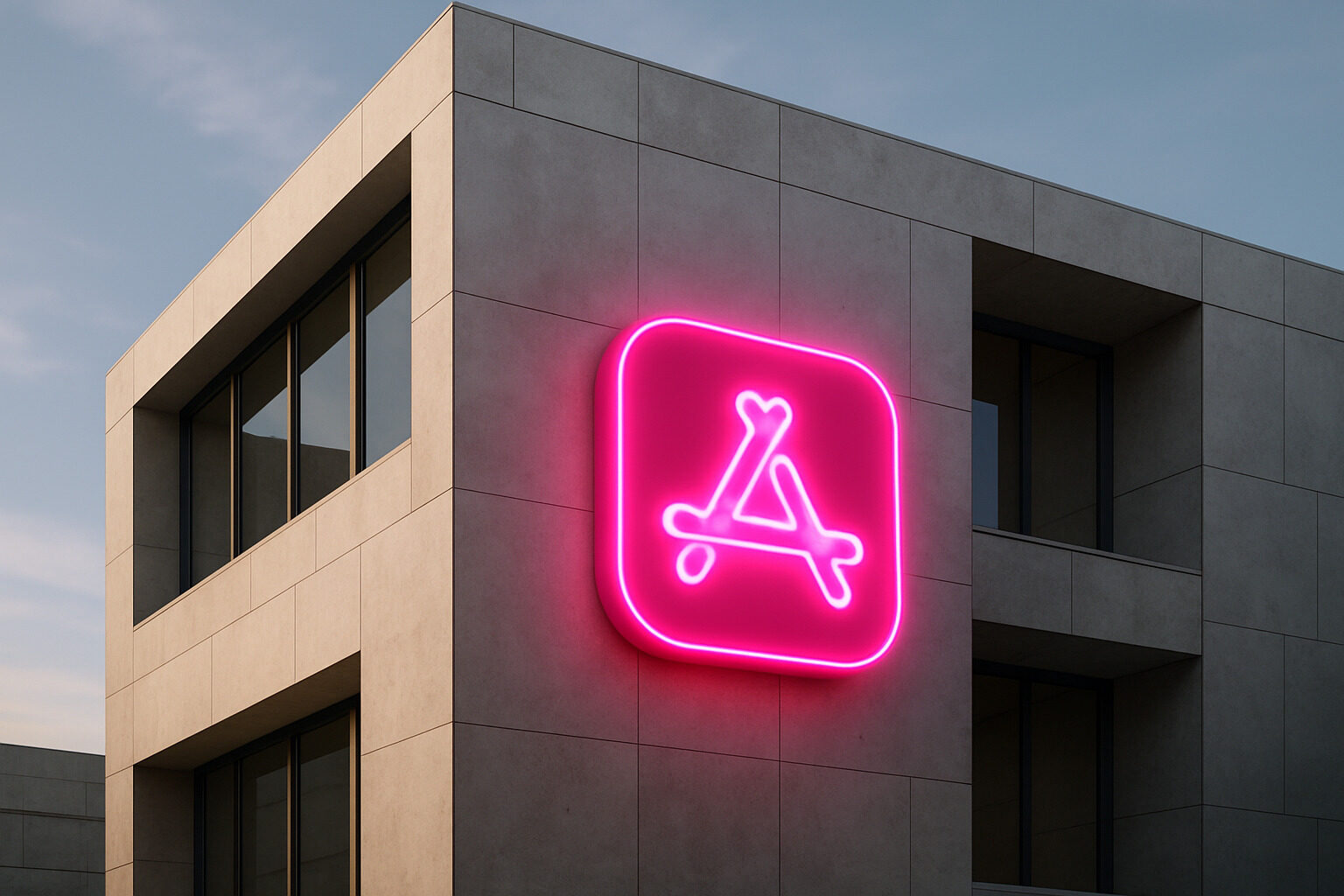
A neon pink app icon works for one simple reason: on a grid of blues, whites, and muted gradients, hot pink is the color nobody else is using. Done well, a neon-pink icon glows on the screen like a sign in a dark street. Done badly, it turns into a smeary blob at small sizes. The difference comes down to a handful of craft decisions — contrast structure, restrained glow, and ruthless legibility testing — and this guide covers each one.
Whether you are designing for a synthwave game, a beauty app, or just chasing shelf visibility, the same fundamentals apply.
Why Neon Pink Works (and When It Doesn't)
Neon aesthetics borrow their power from real neon signage: a saturated light source against darkness. That means the pink itself is only half the design — the dark field around it does the heavy lifting. A magenta glyph floating on a near-black background reads as "neon"; the same magenta on a white background just reads as bright pink. Before committing, check fit: neon pink signals energy, nightlife, retro-futurism, and playfulness. It fights against brands built on calm, trust, or utility, where a quieter accent use of pink may serve better than a full neon treatment.
Restyle your own space with AI
Upload a photo of your room or home and see it reimagined in any style from this article. Your first restyle is free, no account needed.
Restyle My Space
Build the Contrast Structure First
Design the icon in grayscale before touching color. A strong neon icon has three tonal layers:
- A dark ground — deep navy, charcoal, or near-black purple rather than pure black, which can feel flat. Subtle vertical gradients suggest depth.
- The lit element — your glyph or letterform, at maximum brightness. This should be the only high-brightness shape in the icon.
- A mid-tone support layer — optional secondary shapes (a horizon line, a grid, a second outline) sitting clearly between ground and glow.
If the grayscale version is not instantly readable, no amount of pink will save it. One lit element, one ground, nothing competing.
Glow Effects That Survive Small Sizes
Glow is where most neon icons die. On a large canvas, a wide soft outer glow looks gorgeous; scaled down to a home-screen tile, it becomes fog that eats your edges. A few rules keep the glow under control:
- Tight core, modest halo. Real neon tubes have a bright, hard core with falloff around it. Keep a crisp, fully saturated stroke and add a soft glow at low opacity around it — the crisp core is what survives scaling.
- Glow follows the shape. Apply glow to the glyph itself, not as a general haze across the icon.
- One glow color. Pink glow around a pink stroke. Introducing a second glow color (say, cyan) is a deliberate two-tone choice — commit to it structurally, not as decoration.
- Preserve the darks. If glow lifts your background's darkest values too far, the neon effect collapses. Let real darkness remain around the light.
Legibility at Small Sizes
App icons are judged at tiny sizes in search results, settings lists, and folders. Test your design small early and often:
- Reduce to a thumbnail and squint. If the silhouette is not obvious, simplify the glyph.
- Avoid words. Even a short name becomes noise at list sizes; a single letterform or symbol scales far better.
- Thicken strokes beyond what looks right at full size. Thin neon lines that feel elegant on a big canvas vanish at 10 percent scale.
- Check on real wallpapers, light and dark, since the surrounding context changes how the glow reads.
Choosing Your Pinks
| Approach | Palette Character | Feels Like | Watch Out For |
|---|
| Hot pink on near-black | Single saturated hue, dark ground | Classic neon sign, nightlife | Flatness if there's no tonal variation |
| Pink-to-purple gradient | Magenta blending into violet | Synthwave, retro-futurism | Muddy midpoints; keep the gradient short |
| Pink + cyan duotone | Two opposing neons | Cyberpunk, arcade | Competing focal points at small sizes |
| Soft pink glow on pastel | Lower contrast, milky ground | Beauty, lifestyle, vaporwave | Weak shelf presence next to darker icons |
Whichever you choose, verify the exact values on real devices — OLED and LCD screens render saturated magentas differently, and what glows on one can look chalky on another.
Platform Guidelines, in General Terms
Each app marketplace publishes its own icon requirements, and they change over time, so always check the current official documentation before submitting. In general terms, expect the platforms to: supply their own corner-rounding or masking (so design edge-to-edge and never bake in your own rounded corners), require specific sizes and formats without transparency in store contexts, and discourage replicating hardware, official badges, or other apps' marks. Some platforms also support themed or tinted icon variants, which matters for neon designs — test how your icon looks when the system recolors or darkens it, and make sure the silhouette still carries the design when your carefully tuned pink is replaced.
Accessibility and Contrast Checks
Neon aesthetics flirt with two accessibility hazards worth checking deliberately. First, saturated magenta against saturated cyan produces vibration — the shimmering edge effect that makes shapes hard to focus on, especially for users with visual sensitivities. If you use the duotone approach, separate the two hues with a dark boundary rather than letting them touch. Second, pink-on-dark combinations that look punchy at full saturation can have surprisingly weak luminance contrast; run your core glyph color against your background through any standard contrast checker, and if the ratio is marginal, lighten the pink's value rather than pushing saturation further — a slightly lighter, less saturated pink often reads as brighter neon anyway. Finally, never let the glow be the only thing defining an edge: the crisp core stroke should carry the shape for anyone who perceives the halo poorly, including every user viewing the icon at the smallest sizes.
A Practical Production Workflow
- Sketch three to five silhouette ideas in flat grayscale.
- Pick the strongest silhouette and establish the three tonal layers.
- Apply your pink system — core stroke, tight glow, dark ground.
- Export at every required size and view the whole set at once.
- Screenshot the icon into a real home screen mockup next to popular apps; if it disappears, raise contrast or simplify.
- Recheck after any platform mask or theming is applied.
Steal From the Aesthetic's Neighbors
Neon pink icon design borrows from a broader visual family, and studying that family sharpens your instincts. The vaporwave palette — covered in our guide to the vaporwave cafe aesthetic — shows how pink behaves against teal and pastel grounds, while our cyberpunk apartment makeover guide demonstrates the harder pink-and-cyan-against-black register. If you want fast visual references beyond icons, generating neon-lit architectural scenes with our AI designer is an easy way to study how neon light falls on surfaces — observations that translate directly into more convincing glow work. The craft is the same at every scale: darkness first, one bright thing, and the discipline to keep everything else quiet.
Restyle your own space with AI
Upload a photo of your room or home and see it reimagined in any style from this article. Your first restyle is free, no account needed.
Restyle My Space