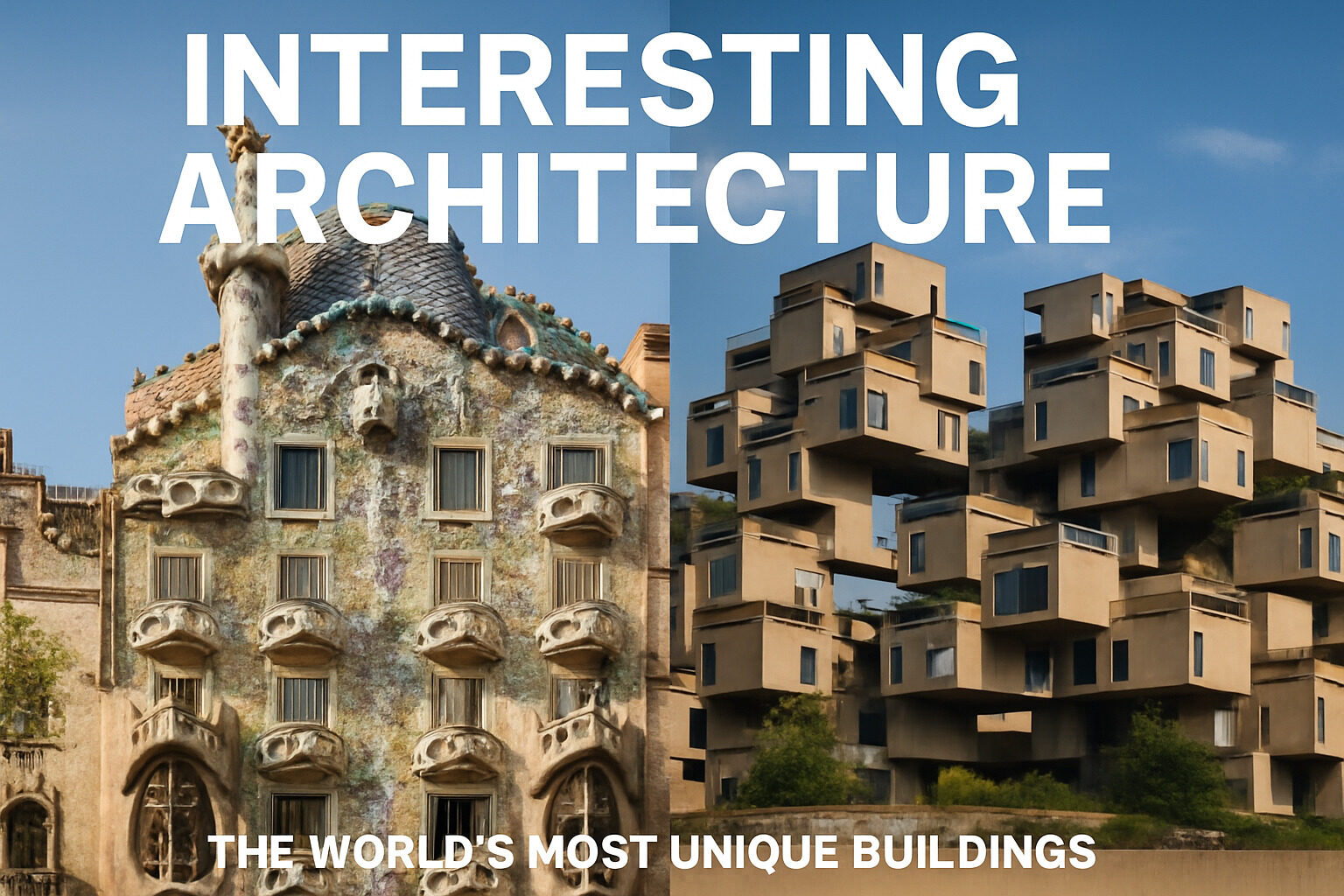
The world's most unique buildings are the ones that make you stop mid-step and ask: how is that standing, and why does it look like that? A Barcelona apartment block with a dragon's back for a roof. A Montreal housing complex stacked like a child's blocks. A temple in Delhi shaped as an unfolding lotus. A Prague office building that appears to be dancing. These are not novelty for novelty's sake — behind every genuinely interesting building is a serious idea pushed further than anyone had dared before.
This tour visits the most celebrated unusual buildings on Earth and unpacks the thinking behind each. By the end, you will have a framework for telling the difference between a gimmick and a masterpiece — they can look surprisingly similar from the sidewalk.
What Makes a Building "Unique"?
Unusual buildings tend to break one of three unspoken rules. Some reject the straight line, like Gaudí's undulating facades. Some reject the standard program, rethinking what a house or office should even be, like Habitat 67. And some reject gravity's usual appearance, leaning, floating, or twisting in ways that make structure itself the spectacle. The best examples do all this while still working beautifully as buildings — people live, work, and worship in every structure on this list.
There is also a test of time. Novelty architecture — the duck-shaped diner, the basket-shaped office — usually gets one laugh and then ages badly, because the joke is the whole idea. The buildings below have instead grown more interesting with age: each one keeps rewarding a second look, and a third, because the strangeness is structural to the thinking rather than painted on top of it.
Gaudí's Living Facades: Casa Batlló
No architect is more associated with architectural strangeness than Antoni Gaudí, and Casa Batlló in Barcelona — a radical remodel of an existing apartment building completed in the early 1900s — is his most concentrated dose. The facade ripples like the surface of a pond, balconies resemble masks or skulls, columns in the lower windows read as bones, and the roof arches like the scaled back of a dragon. Locals nicknamed it the House of Bones.
Yet nothing here is arbitrary. Gaudí studied natural forms because they are structurally efficient, and Casa Batlló's light wells, ventilation, and hand-crafted details were advanced for their day. Together with his Casa Milà down the boulevard and the Sagrada Família across town, it shows a designer inventing a personal language — rooted in the organic curves of Catalan Modernisme and the wider Art Nouveau movement — that no one has convincingly imitated since.
Rethinking the Apartment: Habitat 67 and Rotterdam's Cube Houses
Moshe Safdie was in his twenties when his master's thesis became Habitat 67, built as a pavilion of the 1967 World Exposition in Montreal. Its stacked concrete modules — hundreds of prefabricated boxes piled into an artificial hillside — gave every apartment a garden terrace on a neighbor's roof. It asked a question cities are still trying to answer: can dense housing offer what the suburbs promise?
In Rotterdam, Piet Blom attacked the same problem from a stranger angle. His Cube Houses, built around 1984, tilt each cubic dwelling 45 degrees onto a hexagonal pylon, so residents live inside a forest of yellow tilted dice. Walls lean, windows face the pavement or the sky, and roughly a quarter of the floor area is a geometry puzzle — but the ensemble creates a covered public street beneath, and people happily live there today. Both projects are heroic experiments from modernism's most optimistic decades; see our modernism style page for the movement's broader story.
Sculptural Statements: The Lotus Temple and the Atomium
The Lotus Temple in Delhi, designed by Iranian-Canadian architect Fariborz Sahba and completed in 1986, is a Baháʼí house of worship composed of 27 marble-clad petals arranged in clusters to form a nine-sided flower. It is that rare thing: an instantly legible symbol that is also serene architecture, and it is regularly counted among the most-visited buildings in the world.
Brussels' Atomium, built for the 1958 World's Fair, enlarges an iron crystal's unit cell to a scale 165 billion times life size — nine steel spheres connected by tubes, several of them housing exhibitions, with escalators running through the connecting arms. It was meant to stand for six months. Like the Eiffel Tower before it, the public refused to let it go.
Playful Provocations: The Dancing House and Kunsthaus Graz
Prague's Dancing House (1996), by Frank Gehry with Croatian-Czech architect Vlado Milunić, pairs a pinched glass tower with a solid stone partner mid-twirl — famously nicknamed "Fred and Ginger." Dropped into a row of dignified nineteenth-century facades, it caused an uproar before becoming a beloved fixture; it is a gateway drug to the whole deconstructivist movement, which we chart in our roundup of 10 iconic deconstructivist buildings.
Kunsthaus Graz (2003), by Peter Cook and Colin Fournier, is a biomorphic blue blob squatting among Austrian red-tile roofs — its architects called the approach the "friendly alien." Nozzle-like skylights crane toward the light, and a media facade lets the skin display images at night. Both buildings make the same wager: that a city gains more from one well-judged eccentric than from a block of polite background.
The World's Most Unique Buildings at a Glance
| Building | Location | Designer | What Makes It Unique |
|---|
| Casa Batlló | Barcelona, Spain | Antoni Gaudí | Bone-like facade and dragon-back roof |
| Habitat 67 | Montreal, Canada | Moshe Safdie | Prefab modules stacked into a hillside of homes |
| Cube Houses | Rotterdam, Netherlands | Piet Blom | Cubic homes tilted 45 degrees on pylons |
| Lotus Temple | Delhi, India | Fariborz Sahba | 27 marble petals forming a lotus |
| Atomium | Brussels, Belgium | André Waterkeyn and the Polak architects | An iron crystal enlarged 165 billion times |
| Dancing House | Prague, Czechia | Frank Gehry & Vlado Milunić | Twin towers caught mid-dance |
| Kunsthaus Graz | Graz, Austria | Peter Cook & Colin Fournier | A "friendly alien" blob with a media-facade skin |
How to Read an Unusual Building
When you meet a strange building in the wild, resist the urge to file it under "weird" and move on. Ask three questions instead. What rule is it breaking — form, program, or structure? What problem was the architect actually solving? And does the strangeness serve the people inside, or only the camera outside? Buildings that survive all three questions are the keepers.
- Photograph it and run it through our AI building analyzer to identify its style, influences, and closest relatives.
- Add your find to the community building library — unusual buildings are exactly the ones other explorers most want to discover.
Every building on this list was ridiculed when new. Gaudí's clients were mocked, Safdie's modules were dismissed as utopian, and Prague's traditionalists petitioned against the Dancing House. The lesson of unique architecture is patience: today's oddity has a fair chance of being tomorrow's beloved landmark, and the cities that tolerated the experiment are the ones collecting the postcard revenue now.
See these ideas on a real building
Upload a photo or type an address and get an instant AI architecture analysis. Your first is free, no account needed.
Analyze a Building Free