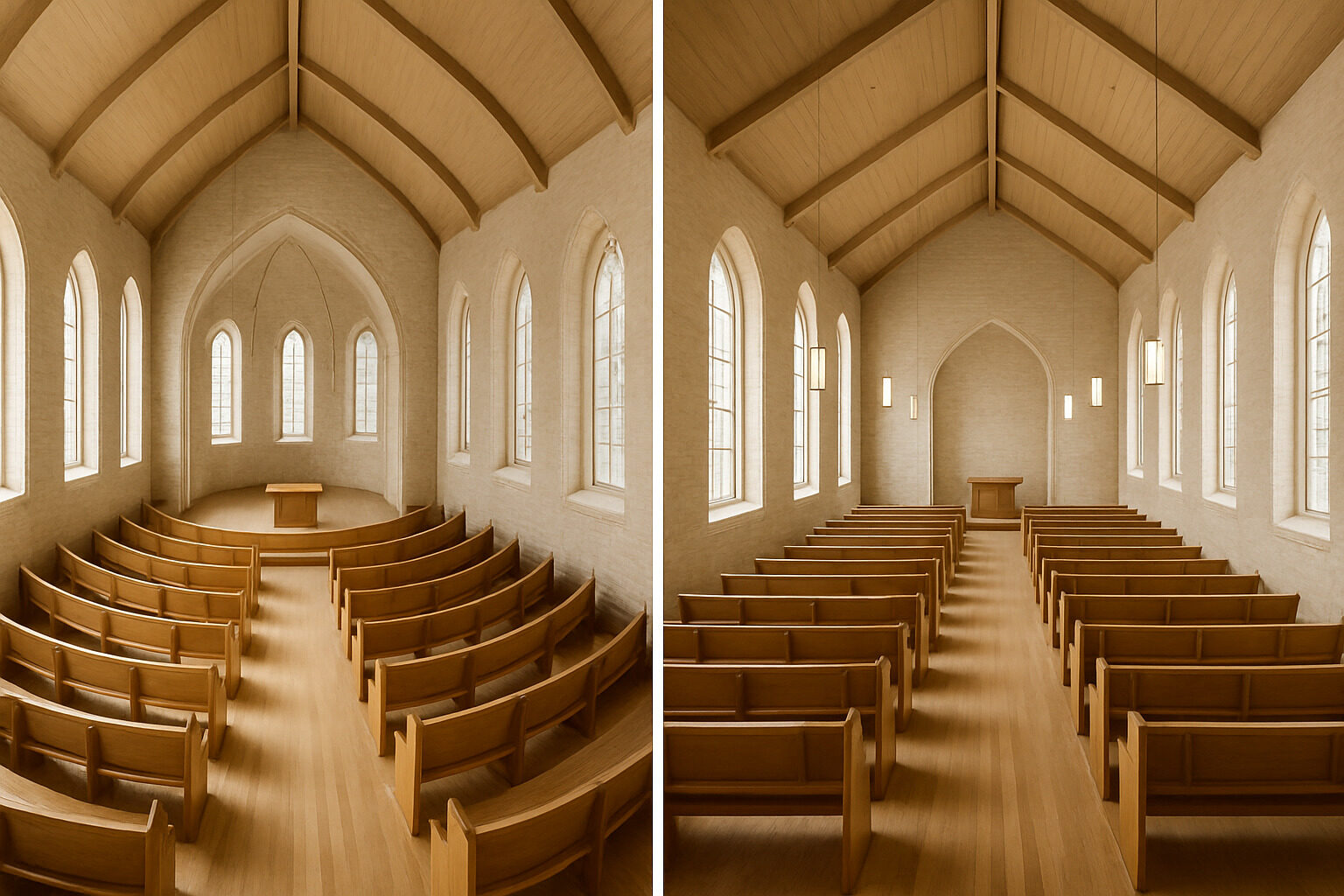
The short answer: linear seating — straight rows facing the sanctuary — suits long, narrow chapels, formal processional liturgy, and tight budgets; radial seating — curved rows arcing around the sanctuary — suits wide or square rooms and congregations that want everyone close, with clear sightlines and a stronger sense of gathering. Neither is universally better. The right choice follows from your room's proportions, your worship style, and how much your community values seeing one another during worship.
This article compares the two configurations directly — history, geometry, sightlines, acoustics, cost, and flexibility — and ends with a simple decision framework.
Definitions: what counts as linear, what counts as radial
Linear seating places parallel straight rows perpendicular to a central axis, usually split by a middle aisle — the arrangement inherited from the basilica plan of early Christian architecture and standard in most historic chapels. Radial (or fan) seating curves each row along an arc centered on the liturgical focal point, so every seat faces the sanctuary directly; the rows may form a shallow fan or wrap as far as a half-circle. Between the pure cases sit angled or "splayed" layouts — straight sections set at angles — which deliver much of radial's benefit with straight, cheaper furniture.
A brief history of each arrangement
Linear seating is the younger tradition than the buildings that house it: for much of the medieval period congregations largely stood, and fixed nave pews became widespread only in the later medieval and Reformation eras, when sermons lengthened and listening became central to worship. The long Gothic nave and the straight pew grew together from that point; our Gothic architecture guide shows the kind of axial interiors that made straight rows feel inevitable.
Radial seating rose with the auditorium church of the nineteenth century, when preaching-centered congregations borrowed theater planning — curved rows, raked floors, wraparound galleries — to put maximum listeners close to the pulpit. Twentieth-century liturgical renewal gave the curve a second, different justification: not acoustics for a preacher, but the visible gathering of the assembly around altar and table. Many chapels reordered since then have traded straight pews for arcs of seating for exactly that reason.
Sightlines and participation
Radial's core advantage is geometric: curving the rows shortens the average seat-to-sanctuary distance and orients every chair toward the focus without the head-turning that end seats in long straight rows require. Worshippers also see one another across the arc, which strengthens congregational singing and the sense of common action — people sing more confidently when they can see others singing.
Linear's advantage is clarity of direction. The uninterrupted axis gives processions, weddings, and funerals a legible path; the view down the aisle to the altar is one of the most powerful images in church architecture, and a fan layout dilutes it. In a narrow room, linear also simply wastes no space, where a fan would collide with the side walls after a few rows.
Acoustics and music
Neither layout is inherently better acoustically, but they fail differently. Long linear rooms put rear worshippers far from unamplified sources and can need reinforcement for speech, while their parallel geometry often supports organ and choir well. Radial rooms keep listeners close — a genuine advantage for speech — but wrap them around the source, so music and speech must project across a wide angle, and curved rear walls can create focusing echoes if not treated. In both cases the honest advice is the same: involve an acoustician once the seating concept is chosen, because remedial acoustics cost more than planned acoustics.
Cost, furniture, and flexibility
Linear layouts are cheaper to furnish: straight pews and standard chairs in straight rows minimize joinery and layout labor. Curved pews are specialist items, and even chair-based radial layouts take more care to set out accurately. Radial geometry also loses some seating efficiency at the fan's outer edges, so a radial room typically needs slightly more floor area for the same capacity. On flexibility, chairs beat pews in either geometry; but note that a radial arrangement of chairs is harder for volunteers to reset accurately than straight rows, so flexible rooms drift toward linear unless someone maintains the curve with floor markings.
Side-by-side comparison
| Factor | Linear seating | Radial seating |
|---|
| Best room shape | Long, narrow naves | Wide, square, or polygonal rooms |
| Average distance to sanctuary | Longer | Shorter |
| Sightlines from edge seats | Angled, require head-turning | Direct |
| Sense of gathered community | Weaker (backs of heads) | Stronger (faces across the arc) |
| Processional axis | Strong and legible | Diluted |
| Furniture cost | Lower (straight pews/rows) | Higher (curved pews, careful setout) |
| Space efficiency | High | Moderate |
| Historic-fabric fit | Natural in most heritage chapels | Often requires reordering consent |
The middle path: splayed and hybrid layouts
Many real chapels end up somewhere between the two pure geometries, and deliberately so. A splayed layout keeps straight rows but angles the outer blocks inward — typically two side sections turned toward the center — so edge seats face the sanctuary without any curved furniture. It preserves a clear central aisle for processions, fits narrower rooms than a true fan, and can often be achieved simply by re-setting existing straight pews on new platforms during a reordering, which heritage authorities tend to view more favorably than wholesale replacement.
Another common hybrid keeps the historic linear nave intact but creates a radial or semicircular gathering of chairs in a transept, a west-end space, or the front third of the nave for smaller weekday congregations. The building keeps its axis for the great occasions; the community gains a close, face-to-face setting for ordinary ones. If your congregation's attendance varies widely between services, this two-mode approach frequently outperforms any single fixed answer.
A decision framework
- Measure the room. If the worship space is more than roughly twice as long as it is wide, radial rarely fits well; strongly consider linear or a gentle splay.
- Name the liturgical priority. Processional, altar-focused liturgy leans linear; assembly-visible, participatory worship leans radial or splayed.
- Count the real congregation. Small congregations in large linear rooms scatter and feel sparse; a radial or U-shaped subset of the space can gather them.
- Check heritage constraints. Removing historic straight pews to create a fan usually needs consent; angled chair layouts within an existing nave are often the achievable compromise.
- Trial before you buy. Tape and borrowed chairs for a month tell you more than any plan drawing will.
For the wider menu of options — antiphonal, in-the-round, U-shaped, and hybrids — see our guide to small modern church interiors, which treats seating alongside lighting and finishes. If you are weighing a reordering, our AI restyle tool lets you upload a photo of your chapel and preview both arrangements before committing, and the style finder quiz can help a building committee articulate the character it is actually seeking.
See this style on real buildings
Browse our library of AI-analyzed buildings and spot the features from this guide in the wild.
Explore All Styles