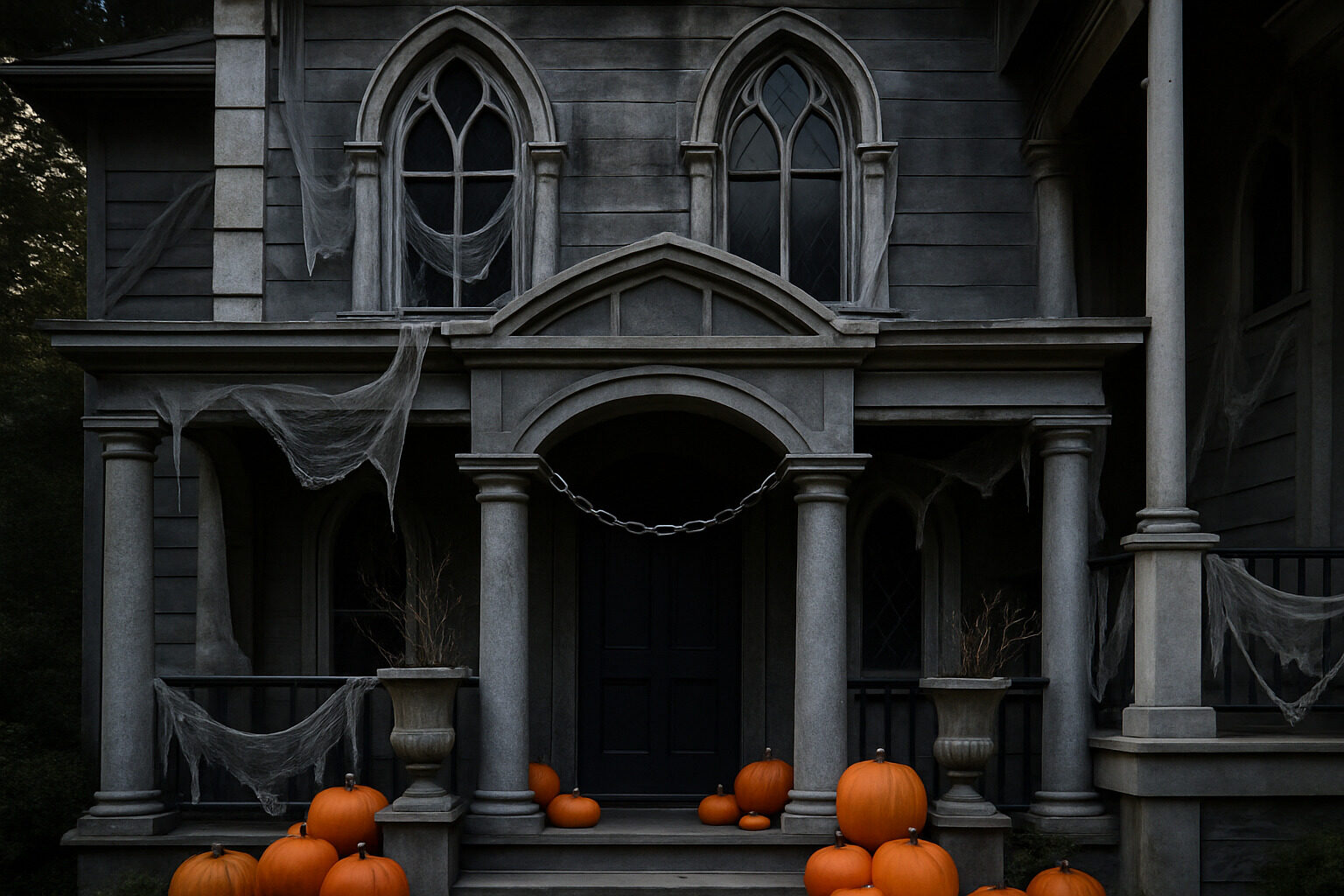
"Ideas para decorar de Halloween" — Spanish for Halloween decorating ideas — usually brings to mind pumpkins, cobwebs and plastic skeletons. But the decorations people remember are architectural. A house that appears to have grown a gothic facade, a porch framed by crumbling columns, an arched graveyard gate at the end of the path: these read as places, not props. The secret is that classic "haunted" imagery is really just architecture — Victorian gables, Gothic arches, classical columns, shuttered windows — exaggerated and aged.
The better news is that architectural Halloween decor is firmly DIY territory. Foam board, cardboard, inexpensive lumber and paint can produce facades, arches and columns that look remarkably convincing at night under the right lighting. This guide walks through the key elements — facade treatments, arches and gates, columns, windows and doors, and porch styling — with practical build notes for each.
Start With the Facade: Instant Haunted House
The facade is the biggest canvas you have, and small interventions transform it. The goal is to shift your home's silhouette and surface toward the haunted archetype: steep gables, dark trim, aged texture, asymmetry. Effective DIY moves include:
- Faux gables and rooflines: cut exaggerated pointed gable shapes from foam board or cardboard, paint them dark, and mount them temporarily above the porch or garage to sharpen the silhouette.
- Board-up effects: lightweight "planks" of foam or thin lath, dry-brushed with gray and brown, angled across windows for the abandoned look — attached with removable methods, never nails into frames.
- Aged texture: gray and green washes sponged onto foam "stone" panels create instant weathering; crackle-effect paint does the rest.
- Shutters askew: foam shutters hung deliberately crooked beside windows are a five-minute trick with outsized effect.
Much of this vocabulary comes straight from real building traditions — the steep gables of northern European townhouses, for instance, which you can read about in our overview of Dutch architecture.
Restyle your own space with AI
Upload a photo of your room or home and see it reimagined in any style from this article. Your first restyle is free, no account needed.
Restyle My Space
Arches and Gates: Framing the Entry
Nothing signals "you are entering another place" like passing under an arch. A pointed Gothic arch — the signature of medieval cathedrals and the entire haunted-house genre — is straightforward to build at yard scale. Cut two mirrored halves from rigid foam insulation board or cardboard, join them at the peak, and support them on posts or tomato stakes driven beside the path. Paint as stone: a base of dark gray, sponged mid-gray mottling, dry-brushed light-gray highlights on the edges.
A cemetery gate takes the idea further: flank the arch with two squat piers, span them with a painted "wrought iron" gate made from PVC pipe or cardboard tubes and foam finials, and letter an ominous name overhead. Position the arch where visitors must actually walk through it — at the path entrance or porch steps — because the physical act of crossing a threshold is what makes the scene immersive. Battery candles or a single uplight at the base complete the effect after dark.
Columns: Classical Ruins in Foam
Columns bring instant gravitas — the difference between a decorated porch and the entrance to a mausoleum. Sonotube concrete-form tubes (from any building supplier), heavy cardboard tubes or stacked foam rings all make convincing column shafts. Wrap the tube in foam sheet scored with horizontal joints to suggest drum construction, add a square foam base and capital, and paint with the same stone technique as the arch.
The trick that sells them is ruin. Perfect columns look like party-store props; broken ones look ancient. Cut the top of one column at a rough angle, chip the foam edges with a rasp, and let a second column stand full height for contrast. A pair flanking the front door, or a broken colonnade lining the path with candle lanterns between, turns an ordinary yard into a ruined temple. Store them dry and they will last for many seasons.
Windows and Doors: The Face of the Haunt
Windows are the eyes of a haunted facade. Backlit silhouettes — a figure, bare branches, a cat's outline cut from black card and taped inside the glass with a warm lamp behind — read from the whole street for almost no cost. Faux tracery takes it further: cut a pointed-arch window surround with quatrefoil details from black foam board and mount it over an existing window to gothicize it instantly.
The door deserves its own scene. A foam surround of carved stone, a knocker upgraded to something monstrous, a wreath of black branches, and warm flickering lanterns on either side transform the threshold trick-or-treaters actually approach. Amber or violet lighting, rather than harsh white, keeps the mood cinematic and the details forgiving.
Porch Styling: Composing the Scene
The porch is where all the elements meet, and composition matters more than quantity. Build in layers: architecture first (columns, arch, window treatments), then large set pieces (lanterns, urns, a bench draped in cloth), then small details (pumpkins massed at different heights, moss, scattered leaves). Keep a clear focal point — usually the door — and frame it symmetrically for classical dread or asymmetrically for decay.
Lighting is half the design. Uplight columns from ground level, keep sources warm and low, and hide the fixtures. And treat safety as part of the craft: keep the walking path wide and lit, anchor tall foam pieces against wind with stakes and fishing line, use only rated outdoor cords and flame-free candles, and keep fabrics away from hot bulbs.
Painting Techniques That Sell the Illusion
Whatever you build, paint is what makes foam read as stone and cardboard read as timber. Three techniques cover nearly every architectural prop. First, the base-and-mottle: roll a dark gray base, then dab lighter grays with a sea sponge for stone texture. Second, dry-brushing: drag an almost-dry brush of pale paint across edges and raised details so they catch imagined light — this is what gives carved profiles their depth at night. Third, the aging wash: thin black or green-brown paint with water, brush it into crevices and wipe the surface, leaving grime exactly where weather would deposit it.
Work outdoors in thin layers, and always test on an offcut — foam can dissolve under solvent-based sprays, so stick to water-based paints. Ten extra minutes of dry-brushing does more for realism than any purchased prop.
Choosing Materials for Each Element
| Element | Best DIY materials | Effort | Reusable? |
|---|
| Facade gables and boards | Foam board, cardboard, lath | Low–medium | Yes, if stored flat and dry |
| Gothic arch / gate | Rigid foam insulation, PVC pipe | Medium | Yes, in sections |
| Columns | Sonotube or cardboard tube, foam sheet | Medium | Yes, several seasons |
| Window tracery and silhouettes | Black foam board, card, lamps | Low | Yes |
| Porch set dressing | Lanterns, cloth, pumpkins, moss | Low | Mostly |
Design It Like an Architect
The most convincing Halloween architecture borrows honestly from real styles — Gothic arches, Victorian gables, classical ruins — so a little style literacy goes a long way. Browse our overview of European architecture styles for the source material behind the spooky canon, and if you want to identify the style of your own house before exaggerating it, our Architecture Explorer can analyze it from a photo. You can even preview dramatic dark restylings of your facade or porch with the AI restyle tool before you cut a single sheet of foam. Build the architecture, light it warmly, age everything — and your house will be the one the neighborhood remembers long after the candy is gone.
Restyle your own space with AI
Upload a photo of your room or home and see it reimagined in any style from this article. Your first restyle is free, no account needed.
Restyle My Space