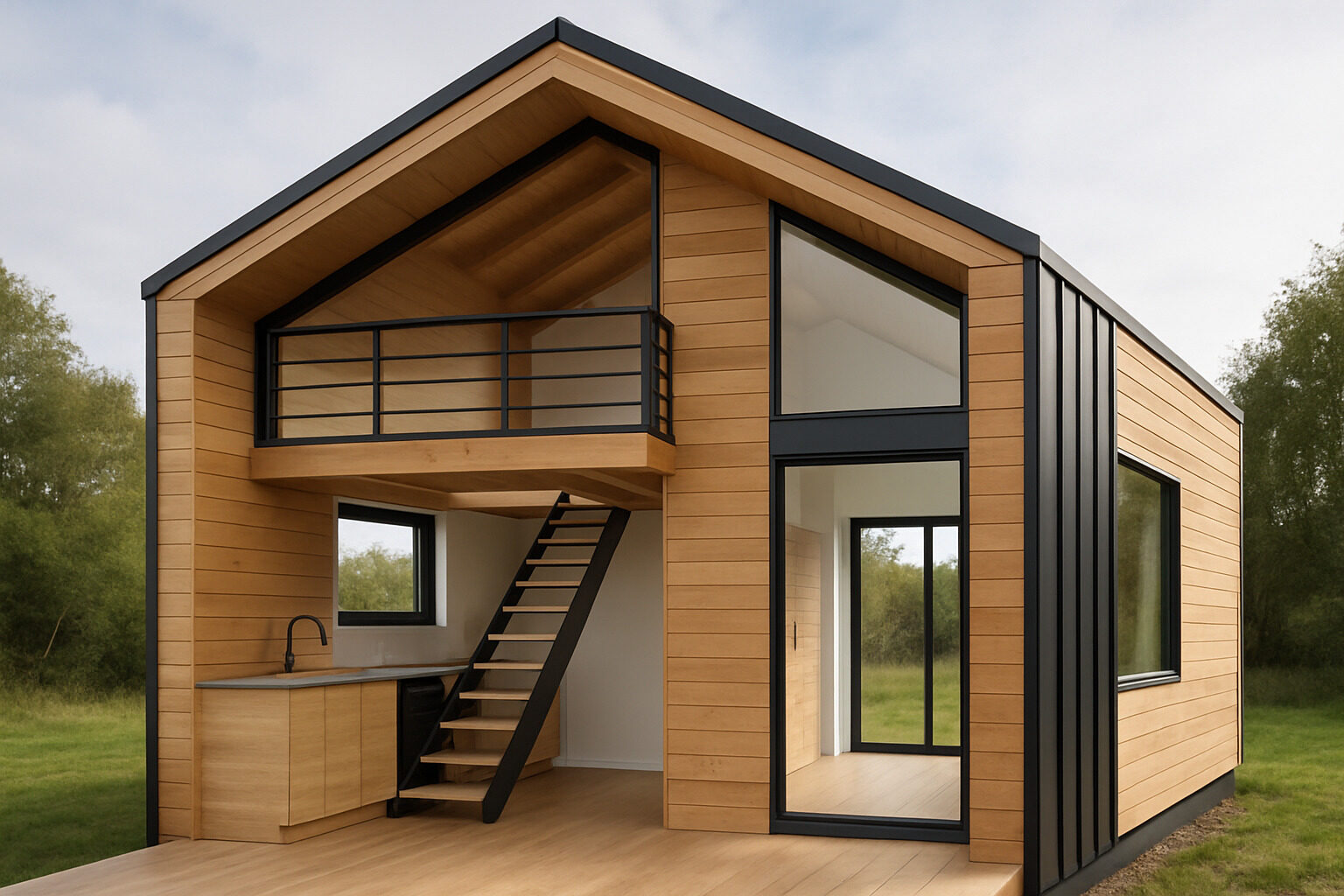
A modern tiny house with a loft pairs clean-lined contemporary design — flat or mono-pitch roofs, large windows, minimal trim, a restrained material palette — with the single most space-efficient move in tiny living: pushing the bed (or an office, or storage) up into the roof volume. The loft frees the main floor for a full kitchen and real seating, while modern styling keeps the small volume feeling open, bright, and intentional rather than cramped and rustic.
This guide covers what makes a tiny house read as "modern," how lofts work in practice, the main layout options, and the design details — glazing, materials, stairs — that separate a sleek build from a dark box on wheels.
What Makes a Tiny House "Modern"
Modern tiny houses share a recognizable vocabulary. Rooflines are simple: a single shed pitch, a flat roof, or a crisp asymmetric gable, usually without overhangs and ornament. Cladding is typically smooth panels, standing-seam metal, or clean horizontal wood in one or two materials rather than a patchwork. Windows are large, often floor-to-ceiling on the living side, with black or dark frames. Inside, cabinetry runs flat-front and handleless, colors stay neutral, and clutter is designed out with concealed storage.
The payoff in a small building is real: uninterrupted lines and big glass make the eye travel further, so the same footprint feels larger than a heavily trimmed traditional interior. If you want the opposite end of the style spectrum for comparison, see our Victorian tiny house guide — the contrast makes modern design decisions much clearer.
Design your own version
Describe the home you are imagining and our AI turns it into concept images in seconds. Your first design is free.
Generate a Design
Loft Fundamentals: Headroom, Access, Air
A sleeping loft is not a second story; it is a platform within the roof volume, commonly with sitting headroom rather than standing height. Three practicalities decide whether it feels great or miserable:
- Headroom: plan for comfortable sitting height at the bed head end at minimum. Shed and asymmetric roofs help by concentrating height where you need it.
- Access: ladders save space but get old fast for nightly use; storage stairs are the modern standard because they add drawers and feel safer.
- Ventilation and light: heat rises, so lofts need an operable window or skylight and, ideally, a ceiling fan or mini-split head nearby.
For a deeper dive into railings, egress, and mattress logistics, our dedicated tiny house loft guide covers the details.
Common Loft Layouts Compared
| Layout | How it works | Best for | Trade-off |
|---|
| Single sleeping loft | One loft over bath/kitchen core | Singles and couples | Guests sleep on a convertible sofa |
| Dual lofts | Loft at each gable end, bridge or open middle | Small families, guest space | Two ladders/stairs eat floor area |
| Loft + main-floor bedroom | Ground-level bed, loft as office/storage | Aging in place, remote workers | Needs a longer footprint |
| Full-height mezzanine | Taller structure, near-standing loft | Foundation builds without height limits | Rarely legal on a road-towed trailer |
If you find yourself wanting standing headroom upstairs and a fixed foundation, you may really be shopping for a small two-story home — compare with our 2-story tiny house breakdown before committing.
Glazing: The Modern Superpower
Large windows are what make modern tiny houses photograph so well, and they matter even more in person. A glazed gable end above the loft, clerestory windows along the high side of a shed roof, or a sliding glass wall onto a deck all extend the perceived space beyond the walls. Orient the biggest glass toward your best view and daylight, and use smaller operable windows on the opposite side for cross-ventilation. In hot climates, plan shading — overhangs, exterior blinds, or deciduous trees — because big glass in a small volume can overheat quickly.
Materials and Palette
Modern tiny interiors typically run light and warm: white or pale walls, one wood tone repeated on floor, stair treads, and shelving, plus black accents in fixtures and window frames. Keep the material count low — two or three finishes carried consistently through the house read as far more expensive than six competing ones. Matte finishes hide fingerprints better than gloss in a space where every surface gets touched daily. Outside, pairing standing-seam metal with a band of natural wood at the entry is a durable, low-maintenance combination that ages gracefully.
Storage Stairs and Multifunction Furniture
The stair to the loft is prime real estate. Modern builds treat it as a cabinet system: deep drawers in the lower risers, a closet or appliance bay in the tall end, sometimes a pull-out desk. Elsewhere, look for pieces that do double duty — a bench that holds shoes, a table that folds against the wall, a sofa with a storage chaise. The discipline is the same as the palette: fewer, better, built-in.
Plan the stair early rather than as an afterthought, because it fixes the position of the loft edge, the kitchen run beneath it, and often the bathroom wall. A stair that lands in the middle of the living zone wastes the very floor area the loft was supposed to free up; one that hugs an end wall keeps the plan open.
Comfort in a Lofted Volume: Heat, Air, and Sound
Open lofted volumes behave differently from room-divided houses. Warm air stratifies, so the loft can run noticeably warmer than the main floor — welcome in winter, punishing in summer. A single well-placed mini-split typically conditions the whole volume, but it needs help moving air: a quiet ceiling or loft fan, an operable skylight or high awning window for stack-effect venting, and floor-level intake on the cool side. Acoustics matter too, since there is no door between the loft and the kitchen below; rugs, upholstered furniture, full bookshelves, and fabric window treatments do most of the softening in an otherwise hard-surfaced modern interior. Finally, think about light spill at night — a partner reading downstairs will light the loft unless you plan a partial screen, curtain, or half-wall at the loft edge. None of these are expensive problems, but all are much easier to solve on paper than after move-in.
Visualize Your Version
Before you lock a design, test it visually. Sketch your floor plan and elevations with the architecture explorer, or photograph a shell, model, or existing tiny house and use the AI restyle tool to see it re-rendered with black window frames, shed roof massing, or a lighter interior palette. Iterating on images is dramatically cheaper than change orders mid-build.
A modern tiny house with a loft is arguably the most livable formula in tiny housing: the loft buys back your floor, the glazing buys back your sense of space, and the restrained palette keeps the whole thing calm. Nail headroom, stairs, and ventilation, and the rest is style.
Design your own version
Describe the home you are imagining and our AI turns it into concept images in seconds. Your first design is free.
Generate a Design