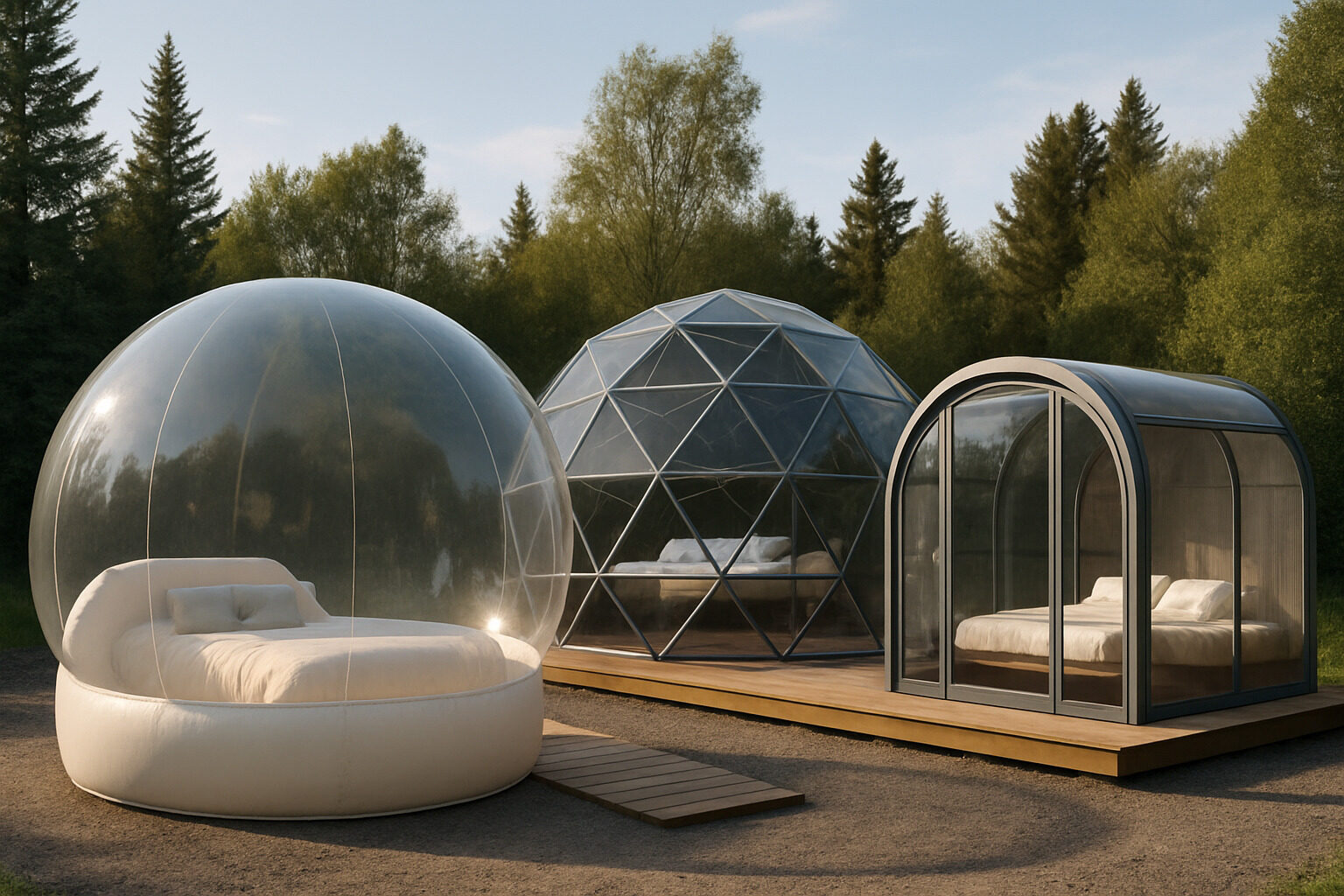
A tiny bubble room is a transparent or semi-transparent dome — usually an inflatable PVC/TPU sphere, a geodesic dome with clear panels, or a rigid polycarbonate pod — used as a glamping suite, stargazing retreat, or garden room. The appeal is obvious: you sleep under the open sky with 180 to 360 degrees of view while staying warm and bug-free. The challenges are equally real: heat gain, condensation, privacy, and siting make or break a bubble room, and this guide covers all four along with the main types on the market.
Bubble rooms are best understood as experience spaces rather than dwellings. Most are a single room of roughly 10 to 20 feet in diameter, furnished with a bed and a couple of chairs, and paired with a nearby bathhouse or a small attached service pod.
The Main Types of Bubble Room
| Type | Structure | Transparency | Durability and notes |
|---|
| Inflatable bubble tent | Air-supported PVC/TPU membrane with constant blower | Fully or partially clear | Cheapest and fastest to deploy; depends on continuous power; membrane life measured in years, not decades |
| Geodesic dome (clear panels) | Metal strut frame with PVC cover and transparent bay | Partial — typically one clear viewing section | Handles wind and snow far better; the mainstream glamping choice |
| Rigid transparent pod | Polycarbonate or acrylic shell on a frame or deck | Full or generous panoramic glazing | Most durable and best insulated of the three; highest cost; some are towable units |
Inflatables suit seasonal or trial use; frames and rigid pods suit year-round hosting. Note that air-supported bubbles deflate without their blower, so backup power is part of the design, not an accessory.
Restyle your own space with AI
Upload a photo of your room or home and see it reimagined in any style from this article. Your first restyle is free, no account needed.
Restyle My Space
Climate Control: The Hard Part
A transparent envelope is essentially a greenhouse, and the physics does not care how romantic the marketing photos are.
Heat gain
Direct summer sun can make an unshaded bubble uninhabitable by mid-morning. Common responses: siting under partial tree canopy, exterior shade sails you can deploy seasonally, reflective or tinted sections on the sun-facing side, and mechanical cooling — typically a small mini-split or portable AC ducted into the space.
Condensation
Warm humid breath meeting a cold membrane at night means fogged walls and drips. Continuous ventilation is the fix: inflatables get this "free" from their blower constantly exchanging air, while dome and rigid pods need vents, a small HRV, or a dehumidifier. Bedding pulled slightly away from the wall and a gentle fan go a long way.
Cold nights
Single-layer membranes insulate poorly, so winter use typically relies on a well-sized heater plus warm bedding rather than envelope performance. Double-layer membranes and rigid twin-wall panels improve matters where offered.
Siting for Stars, Shelter, and Sanity
The site does more work than the product. Prioritize, in order: dark sky (away from yard lights and road glare, with an open view north or toward the Milky Way's seasonal arc), wind shelter (a clearing edge or landform windbreak — membranes are loud and stressed in gusts), morning shade (trees or ridgelines to the east buy you sleep-in time), and drainage (a level, well-drained deck or platform keeps the floor dry and clean). Woodland-edge sites are popular because trees solve shade, wind, and privacy at once; our guide to the small house in the woods covers clearing-edge siting principles that transfer directly. On sloped or wet ground, a raised platform — the same logic as a tiny house on stilts — keeps the bubble level and mud-free.
Privacy Without Losing the View
Sleeping in a fishbowl is the deal-breaker most buyers discover late. Workable solutions include: orienting the clear section toward sky and away from paths; half-opaque designs where only the roof dome is transparent; interior curtain tracks that sweep around the bed zone; planted screens or fencing on the approach side; and simple distance — placing the unit where no sightline exists in the first place. For hosts, one bubble per view corridor is the rule; two bubbles facing each other ruins both.
Time of day changes the equation completely. By daylight, occupants can see out far better than passersby can see in; after dark, any interior light reverses the effect and the bubble becomes a glowing lantern. Design the lighting plan around this: dim, low-mounted, warm sources for evening, blackout curtain coverage for the sleeping zone, and a "stargazing mode" where everything switches off at once.
Furnishing and Running One
Keep contents minimal and moisture-tolerant: a real bed, breathable rugs over the floor membrane, low furniture that does not press the walls, warm low-glare lighting (bright interior light at night turns the walls into mirrors and broadcasts your silhouette). Power typically runs via outdoor-rated cable from a nearby building; water and bathrooms usually stay in a separate service structure to keep humidity out of the bubble. Check local rules before hosting guests — many jurisdictions treat bubbles as temporary structures or campground units, with the same planning questions any small accessory building raises.
What to Ask Before You Buy
Bubble products vary enormously in quality, and glossy renderings hide the differences. Questions that separate serious suppliers from drop-shippers:
- Membrane or panel specification: material, thickness, UV treatment, and expected service life in full sun — clarity typically degrades before the structure fails.
- Wind and snow ratings: ask for actual figures and anchoring requirements, not adjectives.
- Blower details (for inflatables): noise level at the bed, power draw, and what happens during an outage.
- Repairability: can a punctured membrane be patched on site, and can individual panels or sections be replaced?
- Door and airlock design: inflatables need a zipped or double-door entry to hold pressure; poor doors are the most common complaint.
- Warranty and spares: availability of replacement covers years down the line matters more than launch-day price.
As a general pattern, inflatable tents are the least expensive and shortest-lived option, framed domes cost more and last much longer, and rigid pods sit at the top of both scales — commonly priced closer to a small cabin than a tent. Budget for the deck, pathway, power run, shading, and furnishings too; installations often spend as much around the bubble as on it.
Designing the Whole Experience
The best bubble installations are composed like buildings: an approach path, a deck, a service pod, and the dome placed for one specific view. Sketch the site plan and sightlines in the architecture explorer before ordering anything, and browse dome and pavilion precedents in the building library for composition ideas. A bubble room succeeds or fails on siting, shade, airflow, and privacy — get those four right and the product almost does not matter; get them wrong and no product can save the experience.
Restyle your own space with AI
Upload a photo of your room or home and see it reimagined in any style from this article. Your first restyle is free, no account needed.
Restyle My Space