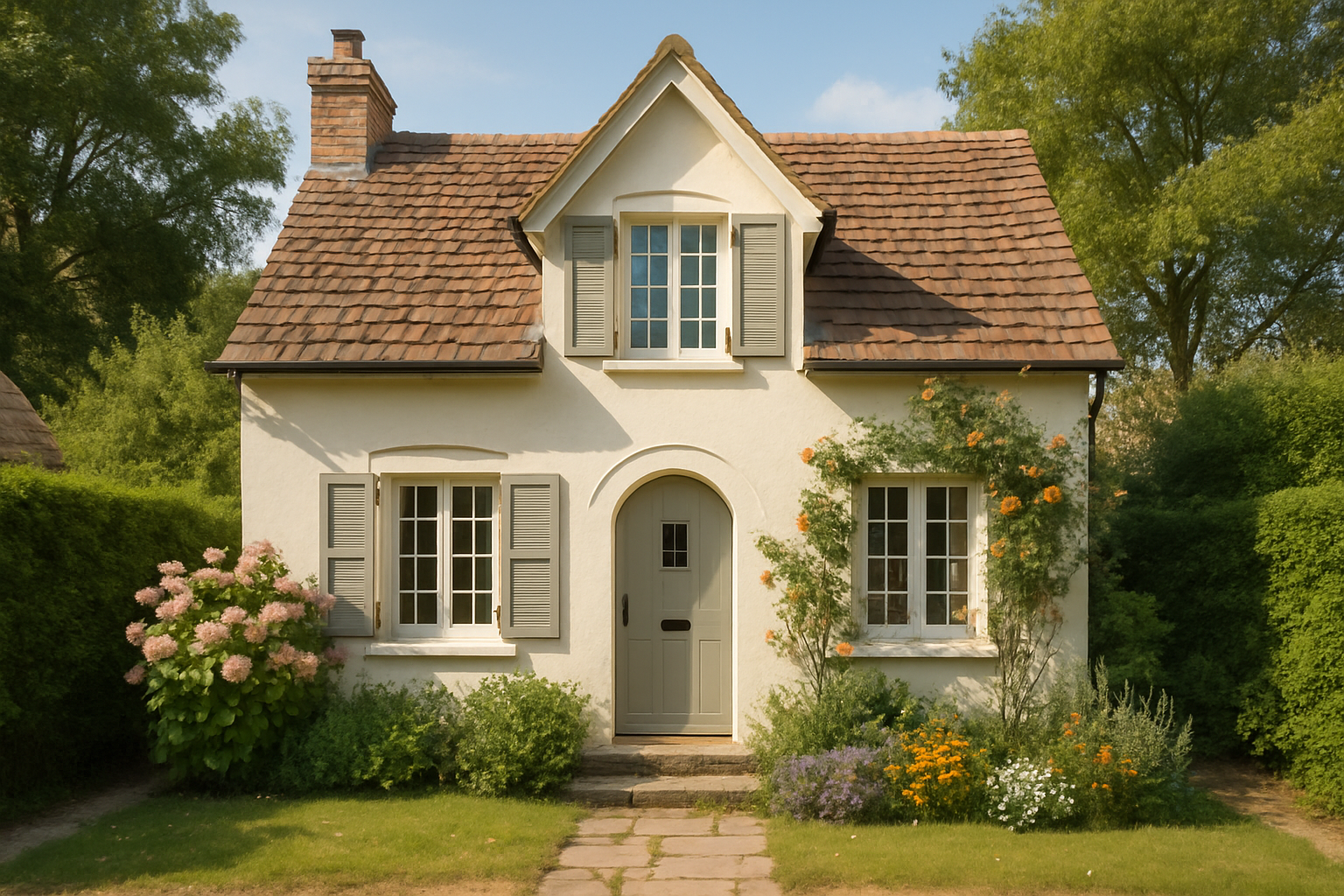
What makes a house cute? It is not size alone, and it is not any single style. Cuteness in architecture comes from a repeatable set of qualities: modest scale, friendly proportions, a roof that dominates the composition, small-paned windows, handcrafted detail, and colors that feel warm rather than imposing. When several of these appear together, the brain reads the building the way it reads anything small and well-proportioned — as approachable, storybook-like, and charming.
This guide breaks down the house styles that most reliably read as cute — cottages, bungalows, storybook houses, A-frames, and their cousins — and then unpacks the underlying design principles, so you can recognize what you are responding to and even borrow it for your own home.
The Classic Cute-House Styles
The Cottage
The cottage is the archetype. Originally modest rural housing in England and northern Europe, the style is defined by a compact footprint, a steep roof that sweeps low over the walls, casement windows with small panes, and a chimney that anchors the silhouette. Modern cottage-style houses keep those cues — low eaves, a prominent front-facing gable, a garden path to an off-center door — and it is the low eave line, bringing the roof close to human height, that does most of the charm work.
The Bungalow
Bungalows, especially the Craftsman bungalows built across North America in the early twentieth century, are cute in a sturdier, more grounded way. One or one-and-a-half stories, a broad low-pitched roof, deep front porch under tapered columns, and exposed rafter tails give the bungalow a hunkered, hospitable posture. The porch is key: it extends the house toward the street like an outstretched hand.
The Storybook House
Storybook (or "fairy-tale") style emerged in 1920s America, when builders — many influenced by Hollywood set design — began exaggerating European cottage features for pure whimsy: deliberately wavy or swooping rooflines, rolled eaves that imitate thatch, turrets with conical caps, arched plank doors with iron strap hinges, and irregular brick or stone. Storybook houses are cuteness turned up to maximum; they succeed because the exaggeration is confident and consistent.
The A-Frame
The A-frame proves cuteness does not require ornament. Its entire personality is one bold move — a roof that runs from ridge to ground, forming the walls — which yields a simple triangular silhouette that people find instantly endearing, like a child's drawing of a house. Popular as vacation cabins since the mid-twentieth century, A-frames pair that geometry with a glass gable end and a small deck, and the charm is complete.
Small Historical Revivals
Plenty of other small houses hit the same notes: Tudor Revival cottages with steep gables and half-timbering, compact Dutch Colonials with gambrel roofs, shotgun houses with gingerbread porch trim, and tiny Gothic Revival farmhouses with a single pointed-arch window. The common denominators are always modest mass and one or two lovable details.
Comparing the Styles at a Glance
| Style | Signature feature | Roof character | Charm mechanism |
|---|---|---|---|
| Cottage | Low eaves, garden setting | Steep, sheltering | Intimacy and enclosure |
| Craftsman bungalow | Deep porch, tapered columns | Broad, low-pitched | Groundedness and welcome |
| Storybook | Swooping rooflines, turrets | Wavy, exaggerated | Whimsy and fantasy |
| A-frame | Triangle silhouette | Roof is the house | Pure geometric simplicity |
| Tudor Revival cottage | Half-timbering, arched door | Steep front gable | Old-world texture |
The Anatomy of Cute: Why These Houses Work
Strip away style labels and the same principles keep surfacing:
- Human scale. Cute houses keep their mass small and their details — doors, windows, porch posts — sized to the body. A low eave or a door you could touch the top of makes a building feel like a companion rather than an institution.
- A dominant roof. In nearly every cute style, the roof occupies a large share of the visible facade. Big roof over small walls signals shelter, and shelter reads as cozy.
- Asymmetry with balance. An off-center door, one dormer, a chimney to the side — informal compositions feel grown rather than engineered, which is friendlier than mirror symmetry.
- Small-paned windows. Divided lites break glass into a texture of little squares and diamonds, adding intricacy at exactly the scale the eye enjoys.
- Warm, saturated-but-soft color. Butter yellow, sage green, dusty blue, warm white trim, a punchy front door. Cute palettes avoid both monumental gray and aggressive brightness.
- Evidence of hand and care. Scalloped trim, window boxes, a curved path, climbing roses. Details that imply someone tends this house are half the effect.
Cuteness Is Mostly Proportion
If one principle outranks the rest, it is proportion. A house reads as cute when its parts relate to each other the way parts of a beloved object do: a roof noticeably taller than the wall below it, windows that are clearly vertical or clearly square rather than vague horizontals, a door that looks slightly small for the facade, a chimney slightly large for the roof. These gentle exaggerations are exactly what illustrators use when drawing houses in children's books, and builders of storybook homes understood it instinctively. The practical takeaway: when you evaluate or modify a house, squint at the silhouette first. If the massing charms at fifty paces, details will only improve it; if the massing is boxy and tall, no shutter or window box can fully rescue it. Cuteness is decided at the scale of the whole before it is decorated at the scale of the part.
Borrowing Cuteness for Your Own House
You do not need to build a turret. The highest-leverage upgrades follow directly from the principles above: repaint in a warm, garden-friendly palette with contrasting trim; give the front door personality with color and hardware; add window boxes and shutters scaled correctly to the windows; soften the approach with a curved path and layered planting; and if you are renovating, favor a porch or a gable accent over adding sheer square footage. Charm compounds through small consistent choices, not one grand gesture.
Curious which of these styles your own home leans toward, or what a listing you love actually is? Upload a photo to our architecture analyzer and it will identify the style and its defining features. If you are still figuring out which direction suits your taste, the style finder is a quick way to discover the aesthetics you consistently respond to.
Cute Continues Indoors
A charming exterior sets expectations the interior should keep. Cottage and bungalow interiors favor painted wood, snug window seats, and collected-over-time furnishings; A-frames want warm wood and simple textiles under all that geometry. Interior character worlds like British Colonial decor show how a strong, consistent vocabulary makes a home feel transporting — the same lesson storybook builders applied outside. And if you want to test how a cozier direction would look in your actual rooms, our AI restyle tool lets you upload a photo and see it re-imagined in cottage, cabin, or any other style in seconds.
Cute houses endure because they promise something at a glance: warmth, care, and a life lived at a human scale. Learn the vocabulary — big roof, small mass, sweet details — and you will see it everywhere, and know exactly how to create it.