Both styles have white or cream stucco walls, low-pitched roofs of red clay tile, and arched openings, which is why real estate listings use the names interchangeably. The difference is attitude. Spanish Colonial Revival is deliberately plain and rustic: asymmetrical, with almost no eaves, ornament concentrated around a single doorway, wrought-iron grilles, and thick walls that look hand-built. Mediterranean Revival is grand and formal: symmetrical facades, broad bracketed eaves, columns and pilasters, balustrades, loggias, and the general air of an Italian villa or a Riviera hotel. If the house looks like a mission or a ranch that got rich slowly, it is Spanish. If it looks like it was built rich, with a fountain out front, it is Mediterranean.
Spanish Colonial Revival vs. Mediterranean Revival: How to Tell Them Apart
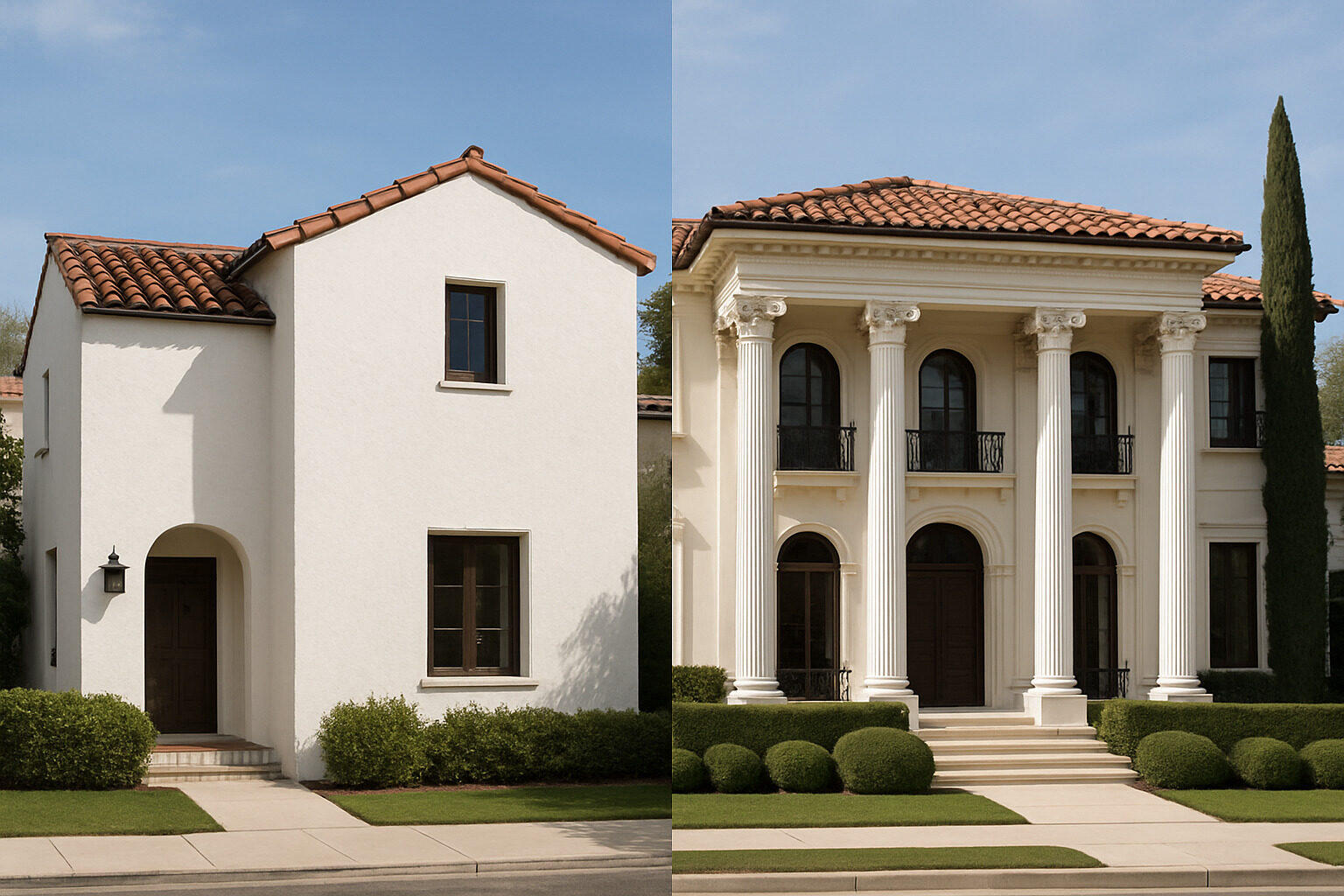
The Two at a Glance
| Feature | Spanish Colonial Revival | Mediterranean Revival |
|---|---|---|
| Peak years | About 1915 to 1940 | About 1918 to 1940, with a revival since the 1980s |
| Inspiration | Spanish missions and colonial buildings of the Americas; Andalusian farmhouses | Italian Renaissance villas, Spanish palaces, and the French and Italian Riviera |
| Symmetry | Asymmetrical, with wings and towers added as if over time | Symmetrical, with a centered entrance |
| Eaves | Little or none; the tile meets the wall | Broad overhangs, often on carved brackets |
| Ornament | Sparse; concentrated on the door surround, sometimes in elaborate carved stone | Classical: columns, pilasters, cornices, balustrades, quoins |
| Iron and wood | Wrought-iron window grilles and balconies; heavy carved wooden doors | Ironwork used decoratively; more stone and marble |
| Openings | Small windows in thick walls; one or two large arches | Arcades and loggias with rows of arches; French doors onto terraces |
| Where | California, Florida, Texas, Arizona, New Mexico | Florida and Southern California above all; resort towns everywhere |
Spanish Colonial Revival: The Mission Made Modern
The style has a birthday. The Panama-California Exposition, which opened in San Diego's Balboa Park in 1915, was designed by Bertram Goodhue in a lavish version of Spanish colonial architecture, and it convinced Californians that this, rather than the Mission Revival of the previous two decades, was the region's rightful style. When an earthquake leveled downtown Santa Barbara in 1925, the city rebuilt in Spanish Colonial Revival by ordinance, and the architect George Washington Smith gave the style its purest domestic form there: plain white walls, deep-set windows, a single carved doorway, and a courtyard behind. In Florida the style shaped Coral Gables and much of Palm Beach, and it spread through Texas and the Southwest in the 1920s.
What to look for: stucco that is smooth or hand-troweled rather than flat; tile roofs with almost no overhang; a facade that does not match on either side of the door, often with a tower or a wing set at an angle; windows of different sizes, small and deep-set, some with wrought-iron grilles; a heavy plank or paneled door under the one decorated element on the house; a courtyard or walled patio; and decorative tile on stair risers and around fountains. Grand versions borrow the Churrigueresque style of Spanish Baroque for the doorway and stay plain everywhere else. See where it started in our San Diego guide and its colonial ancestor in the adobes of Monterey, or browse the Spanish Colonial Revival library alongside the original Spanish Colonial buildings.
Mediterranean Revival: The Villa on the Coast
Mediterranean Revival is the style of the 1920s boom in Florida and Southern California, and it aimed higher on the social scale. Its models were Italian Renaissance villas, Spanish palaces, and the hotels of the Riviera, and its patrons wanted symmetry, columns, and terraces. Addison Mizner set the tone in Palm Beach and Boca Raton, mixing Spanish and Italian sources into houses and clubs with loggias, arcaded courtyards, and roofs of antique tile he imported or manufactured to look old. George Merrick's planned city of Coral Gables adopted the style wholesale, and the 1920s hotels of Miami and Los Angeles spread it as the look of leisure. Since the 1980s a stripped-down version has become the default for large houses across the Sun Belt, which is why so many gated communities are described as Mediterranean.
What to look for: a symmetrical front with the door in the middle; broad eaves on carved brackets; a row of arches forming an arcade or loggia; classical detail such as pilasters, quoins at the corners, balustrades on the terraces, and a cornice; French doors and large windows rather than small punched openings; and formal landscaping with a fountain or a paved forecourt. Compare local examples in Miami, San Diego, and Monterey, or the full Mediterranean Revival library. Our post on Mediterranean architecture's cross-cultural influences covers the sources the revival drew on.
Where the Confusion Comes From
- Same materials. Stucco, red tile, and arches belong to both, so the first glance settles nothing.
- Same decades and places. Both flourished from about 1918 to 1940 in Florida and California, often on the same street, sometimes by the same architect.
- Listing language. Mediterranean has become a catch-all for any tile-roofed house, and Spanish for any with an arch.
- Deliberate blends. Mizner and his contemporaries mixed Spanish rusticity with Italian formality on purpose, and the results resist a single label.
A Three-Question Test
- Is the front symmetrical? A centered door with matching sides is Mediterranean. An off-center door and mismatched wings is Spanish.
- Do the eaves overhang? Broad bracketed eaves are Mediterranean. Tile that stops at the wall is Spanish.
- Where is the ornament? Spread across the facade in columns, quoins, and balustrades is Mediterranean. Concentrated on one doorway, with iron grilles elsewhere, is Spanish.
Many 1920s houses score on both sides. Upload a photo to have the Spanish, Italian, and Mission influences weighed separately.
Frequently Asked Questions
What is the difference between Mission Revival and Spanish Colonial Revival?
Mission Revival, from about 1890 to 1915, copies the California missions directly: curved parapets, bell towers, and arcades, with little other ornament. Spanish Colonial Revival, which replaced it after 1915, draws on the whole range of Spanish and Spanish-American architecture and is more varied and more domestic.
Is Tuscan style the same as Mediterranean Revival?
Tuscan is a marketing name from the 1990s and 2000s for a rustic Italian-farmhouse version of Mediterranean Revival, with stone veneer, tile roofs, and earth tones. It belongs to the Mediterranean family but is plainer and less classical than the 1920s originals.
Why are these styles concentrated in Florida and California?
Both states boomed in the 1920s, both have Spanish colonial histories that made the style feel local, and both have climates where courtyards, terraces, and thick stucco walls make practical sense.