The fastest way to separate the two medieval styles is the shape of the arch. Romanesque arches are round, like the Roman arches they imitate; Gothic arches are pointed. Everything else follows from that. Because a round arch pushes outward as much as downward, Romanesque builders needed thick walls and could only cut small windows into them, so their churches are dark, heavy, and fortress-like. The pointed arch directs weight more steeply downward, and combined with ribbed vaults and flying buttresses it let Gothic builders thin the walls into frames for enormous stained-glass windows, so their churches are tall, bright, and seem to weigh nothing. Romanesque came first, roughly 1000 to 1150; Gothic followed, roughly 1140 to 1500.
Romanesque vs. Gothic: How to Tell Them Apart
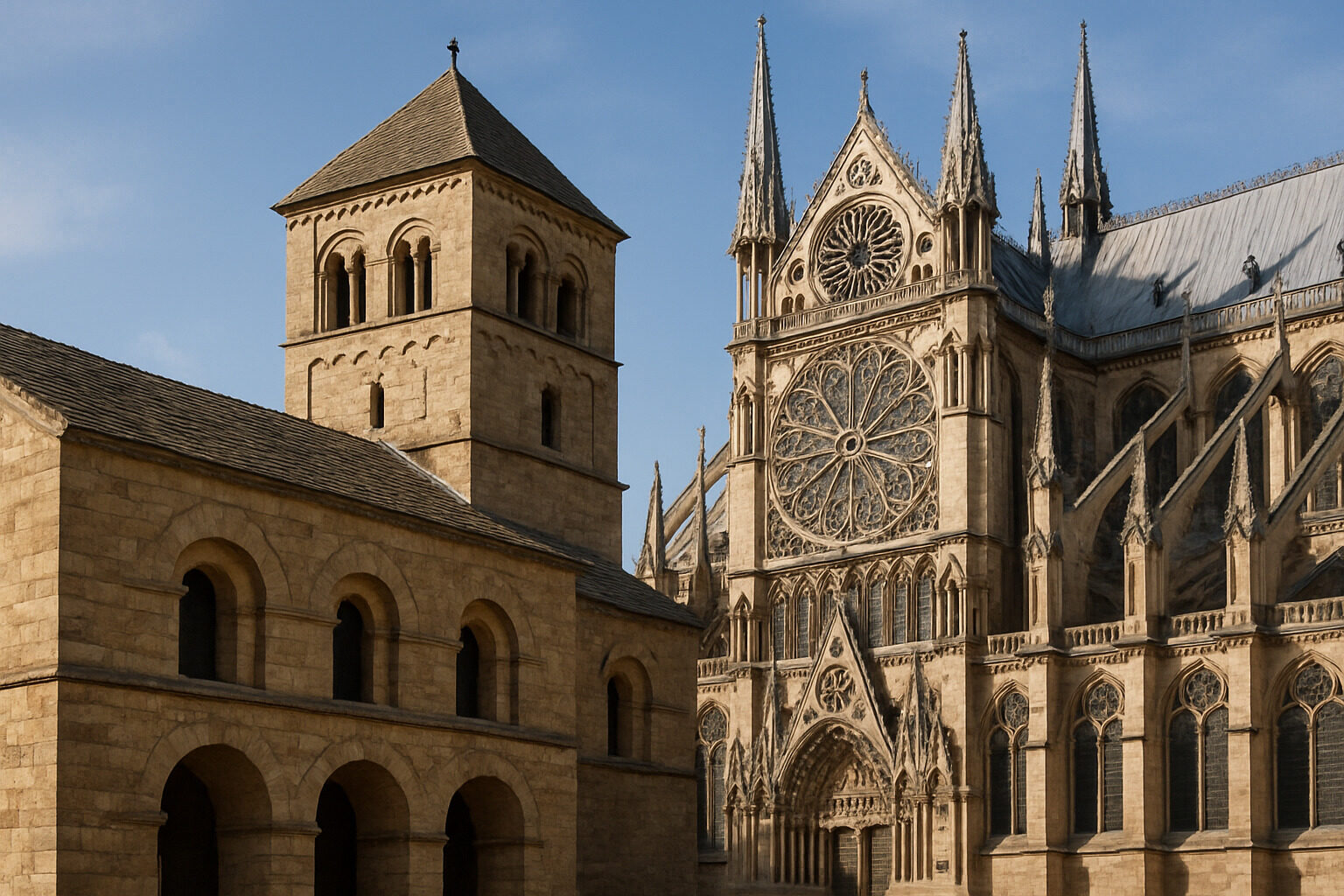
The Two Styles at a Glance
| Feature | Romanesque | Gothic |
|---|---|---|
| Dates | About 1000 to 1150 (later in some regions) | About 1140 to 1500 |
| Arches | Round | Pointed |
| Walls | Very thick; the wall carries the roof | Thin; piers and buttresses carry the roof |
| Windows | Small and few | Huge, filled with stained glass and stone tracery |
| Vaults | Barrel vaults and simple groin vaults | Ribbed vaults, growing more complex over time |
| Buttresses | Flat strips against the wall | Flying buttresses arching over the aisles |
| Height | Broad and squat | Tall and narrow, with spires |
| Light inside | Dim | Bright and colored |
| Sculpture | Stiff, stylized figures, mostly around the doorway | Naturalistic figures crowding portals, gables, and pinnacles |
| Famous examples | Durham Cathedral, Speyer Cathedral, Pisa Cathedral, Sainte-Foy at Conques | Chartres, Notre-Dame de Paris, Cologne, Salisbury, Westminster Abbey |
Romanesque: Built Like a Fortress
The name is a nineteenth-century invention meaning "in the Roman manner," because the style revived the round arch and the barrel vault of ancient Rome. It emerged across Europe around the year 1000, when monasteries were growing rich and pilgrimage routes needed churches big enough for crowds. The great abbey at Cluny in Burgundy set the pattern, and pilgrimage churches such as Sainte-Foy at Conques and Saint-Sernin in Toulouse followed it: a long nave under a stone barrel vault, aisles on either side, a ring of chapels around the altar so pilgrims could circulate, and massive towers over the crossing and the west front.
A stone vault is heavy and pushes outward along its whole length, so the walls beneath had to be enormously thick and pierced only by small openings. That is why Romanesque interiors feel cave-like and why the exteriors look defensive. The decoration concentrates on the doorway, where a half-round panel called a tympanum shows Christ in Judgment in stiff, elongated figures, and on the capitals of the columns, carved with monsters and biblical scenes. In England the style is called Norman; Durham Cathedral, begun in 1093, is its masterpiece and is also where builders first experimented with the ribbed vaults that would make Gothic possible. You can see Romanesque buildings in our guides to Bruges and Kraków, or in the Romanesque section of the library.
Gothic: Built Like a Skeleton
Gothic begins in the 1140s with Abbot Suger's rebuilding of the abbey church of Saint-Denis outside Paris, where three existing devices were combined for the first time. The pointed arch could span any width at any height, freeing the plan. The ribbed vault gathered the roof's weight onto a few points instead of spreading it along the wall. The flying buttress carried that weight out over the aisles to freestanding piers. Together they turned the wall into a skeleton that could be filled with glass. Within a century the results were Chartres, Reims, Amiens, and Notre-Dame de Paris, each taller and brighter than the last.
The style evolved for three hundred years. Early Gothic still has heavy walls and simple lancet windows. High Gothic of the thirteenth century adds the great rose windows and elaborate tracery. Late Gothic, called Flamboyant in France and Perpendicular in England, turns tracery into lacework and vaults into fans. Throughout, sculpture multiplies: figures on every portal, gargoyles at the gutters, pinnacles and crockets along every roofline. Gothic also spread beyond churches to town halls, guild halls, and castles, especially in the trading cities of Flanders and central Europe. See examples in Bruges, Kraków, Barcelona, and the Gothic library.
The Revivals: Why a Building in Minneapolis Looks Romanesque
Both styles were copied in the nineteenth century, so outside Europe you are almost always looking at a revival. Gothic Revival dominated churches and universities in Britain and America from the 1830s onward; we cover how to spot it in Gothic vs. Gothic Revival. The Romanesque revival is more specifically American and is named for one architect: Henry Hobson Richardson, whose Trinity Church in Boston (1877) and Allegheny County Courthouse in Pittsburgh (1888) set the pattern of rough-cut stone, deep round-arched entrances, squat towers, and bands of small windows. Richardsonian Romanesque was the favored style for courthouses, libraries, and train stations in the 1880s and 1890s, and Minneapolis City Hall is a fine example; browse more in Romanesque in Minneapolis and the Romanesque Revival library.
A Three-Question Test
- Round or pointed? Check the tops of the windows and doors. Round means Romanesque; pointed means Gothic.
- How much glass? Small windows in thick walls are Romanesque. Walls that are mostly window are Gothic.
- Anything flying? Arched buttresses leaping over the side aisles exist only in Gothic. Flat strips of masonry against the wall are Romanesque.
Transitional buildings from around 1150 to 1200 mix both, and many churches were started in one style and finished in the other. Upload a photo to get each influence scored on its own.
Frequently Asked Questions
Which came first, Romanesque or Gothic?
Romanesque. It flourished from about 1000 to 1150, and Gothic developed out of it in the 1140s in northern France.
Is Notre-Dame de Paris Romanesque or Gothic?
Gothic. It was begun in 1163 and is one of the earliest cathedrals to use flying buttresses on a large scale.
What does Romanesque mean?
Roman-like. Nineteenth-century historians coined the term for medieval buildings that revived the round arches and vaults of ancient Rome, distinguishing them from the pointed-arch Gothic that followed.
See this style on real buildings
Browse our library of AI-analyzed buildings and spot the features from this guide in the wild.
Explore the Style