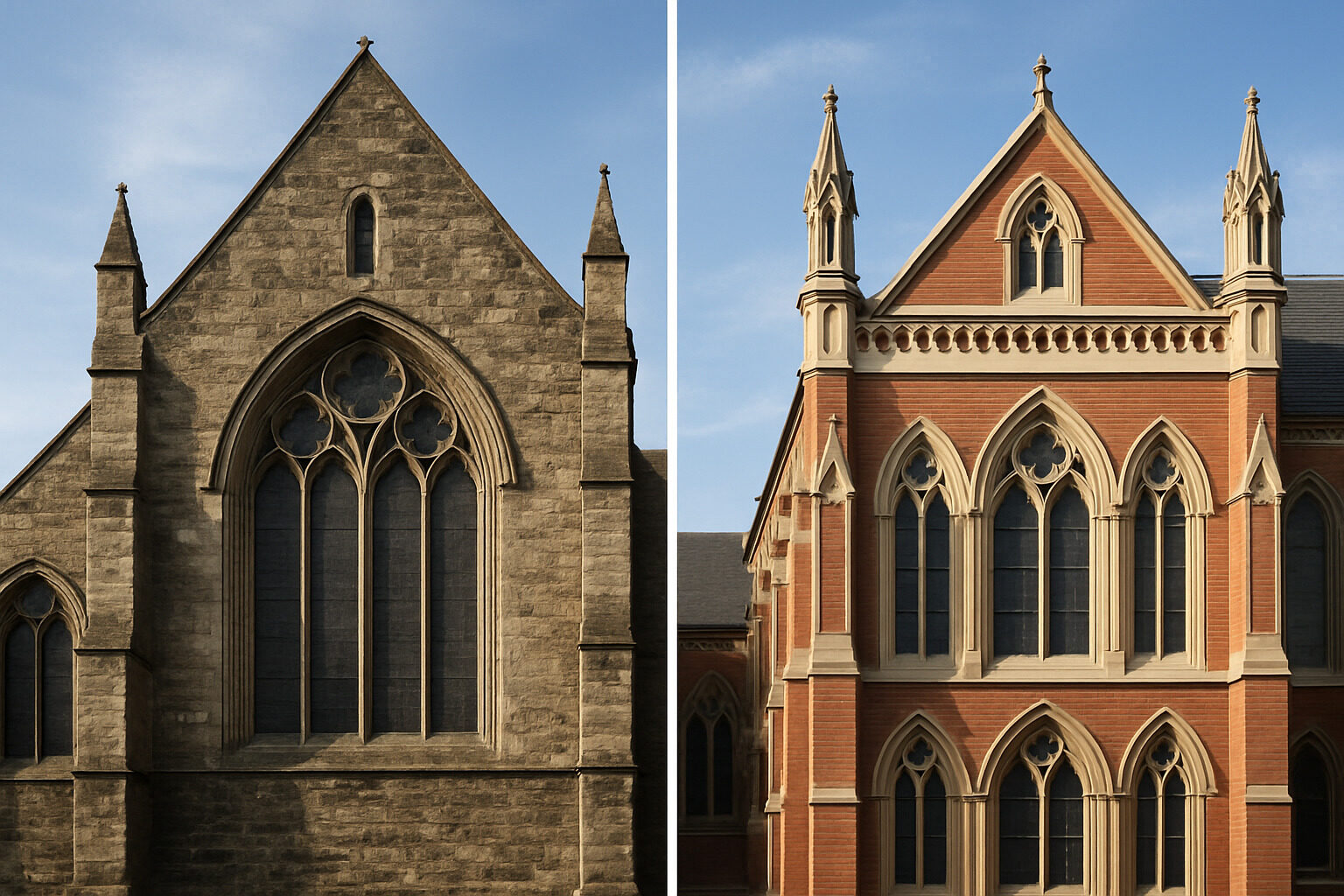
Gothic architecture is the medieval original: the cathedrals, abbeys, and guild halls built in Europe from about 1140 into the 1500s, where pointed arches, ribbed vaults, and flying buttresses were structural inventions that let stone walls dissolve into glass. Gothic Revival is the later imitation, beginning in eighteenth-century England and peaking in the nineteenth century, that borrowed the same look for churches, universities, parliaments, train stations, and houses. The fastest test is geography and date: if the building stands in the Americas, Australia, or anywhere else with no medieval European past, or if it was built after about 1750, it is Gothic Revival.
Inside Europe the question is harder, because revival architects were skilled and many medieval buildings were heavily restored by the same people. The clues below will sort out most cases.
The Two at a Glance
| Feature | Gothic | Gothic Revival |
|---|
| Dates | About 1140 to the early 1500s | About 1750 to the early 1900s, strongest 1830 to 1900 |
| Where | Europe, starting in the region around Paris | Worldwide, especially Britain, North America, Australia, and India |
| Structure | Load-bearing stone; buttresses and vaults do real work | Often brick, iron, or steel underneath; Gothic features may be decorative |
| Building types | Cathedrals, abbeys, town halls, a few castles | Churches, universities, parliaments, stations, houses, even skyscrapers |
| Construction time | Decades to centuries, with visible changes in style | Usually a few years, to a single consistent design |
| Finish | Hand-cut stone, weathered and irregular | Machine-cut stone, crisp and uniform; brick and cast iron common |
What Makes Medieval Gothic Different
The style begins with the rebuilding of the Abbey of Saint-Denis outside Paris in the 1140s, where three existing ideas were combined for the first time: the pointed arch, which directs weight downward more steeply than a round one; the ribbed vault, which concentrates the roof's load onto a few points; and the flying buttress, which carries that load outside the building. Together they meant the wall no longer had to hold the roof up, so it could be opened for enormous windows. Chartres, Notre-Dame de Paris, and Cologne all follow from that idea.
Because these buildings took generations to finish, they are rarely consistent. A nave may be a century older than its towers, and two towers on the same facade often do not match. That irregularity is one of the most reliable signs of the real thing. You can see medieval Gothic in context in our guides to Bruges, Kraków, and Barcelona.
How the Revival Happened
The revival started as a fashion. Horace Walpole began turning his villa at Strawberry Hill, near London, into a miniature Gothic castle in 1749, using pointed arches and plaster vaults purely for atmosphere. By the 1830s the mood had become serious. The architect Augustus Pugin argued that Gothic was the only honest and Christian way to build, and when the Palace of Westminster burned in 1834 it was rebuilt in Gothic dress by Charles Barry, with Pugin designing the detail. The critic John Ruskin gave the movement its moral vocabulary, and for the rest of the century Gothic was the default for churches and colleges across the English-speaking world.
In the United States the style took three distinctive forms. Carpenter Gothic translated pointed windows and lacy bargeboards into wood for small houses and country churches; the farmhouse in Grant Wood's painting American Gothic is a real example in Eldon, Iowa. Collegiate Gothic gave Princeton, Yale, and the University of Chicago their quadrangles. And in 1913 the Woolworth Building wrapped a steel-framed skyscraper in Gothic terracotta, earning the nickname the Cathedral of Commerce. Browse examples in New York, London, and Edinburgh, or the full Gothic section of the building library.
Five Clues You Are Looking at a Revival Building
- It is too regular. Matching towers, evenly spaced bays, and identical carvings suggest a single architect and a short building campaign.
- The stone is too crisp. Nineteenth-century stone was cut by machine and has had far less time to weather. Red brick with stone trim is almost always Victorian.
- The buttresses do nothing. On a steel or iron frame they are ornament. If they are shallow, evenly sized, and carry no obvious load, they are revival.
- The building type did not exist in the Middle Ages. Railway stations, libraries, law courts, and suburban houses are revival by definition.
- The glass and iron give it away. Large sheets of glass, cast-iron columns, and iron roof trusses are industrial-age materials.
Still unsure about a particular church or hall? Upload a photo and the analysis will tell you which features point to each period.
Frequently Asked Questions
Is Notre-Dame de Paris Gothic or Gothic Revival?
It is medieval Gothic, begun in 1163. However, the spire that burned in 2019 and much of the sculpture were nineteenth-century additions by the restorer Eugène Viollet-le-Duc, so parts of what visitors see are revival work on a Gothic building.
Are the Houses of Parliament in London Gothic?
They are Gothic Revival. Apart from Westminster Hall and a few other survivors, the palace was rebuilt between 1840 and 1876 after the fire of 1834.
What is the difference between Gothic Revival and Neo-Gothic?
They mean the same thing. Neo-Gothic is more common in continental Europe, Gothic Revival in Britain and North America, and Victorian Gothic usually refers to the more colorful, polychrome brick version from the 1850s onward.
See this style on real buildings
Browse our library of AI-analyzed buildings and spot the features from this guide in the wild.
Explore the Style