A Colonial house was built during the colonial period, roughly 1600 to 1780, and there are not many left. A Colonial Revival house imitates that look and was built any time from the 1880s to last year; there are millions. The fastest test is the windows. Original Colonial windows have many small panes, often nine or twelve per sash, because glass was hand-blown and small. Colonial Revival windows have fewer, larger panes, typically six over six or eight over eight, or a single pane with a snap-in grille imitating the old pattern. After that, look at scale: the revival version is bigger, taller, and more emphatic in every detail, with a wider door surround, fatter columns, and a fanlight the original builder could not have afforded.
Colonial vs. Colonial Revival: How to Tell the Original from the Copy
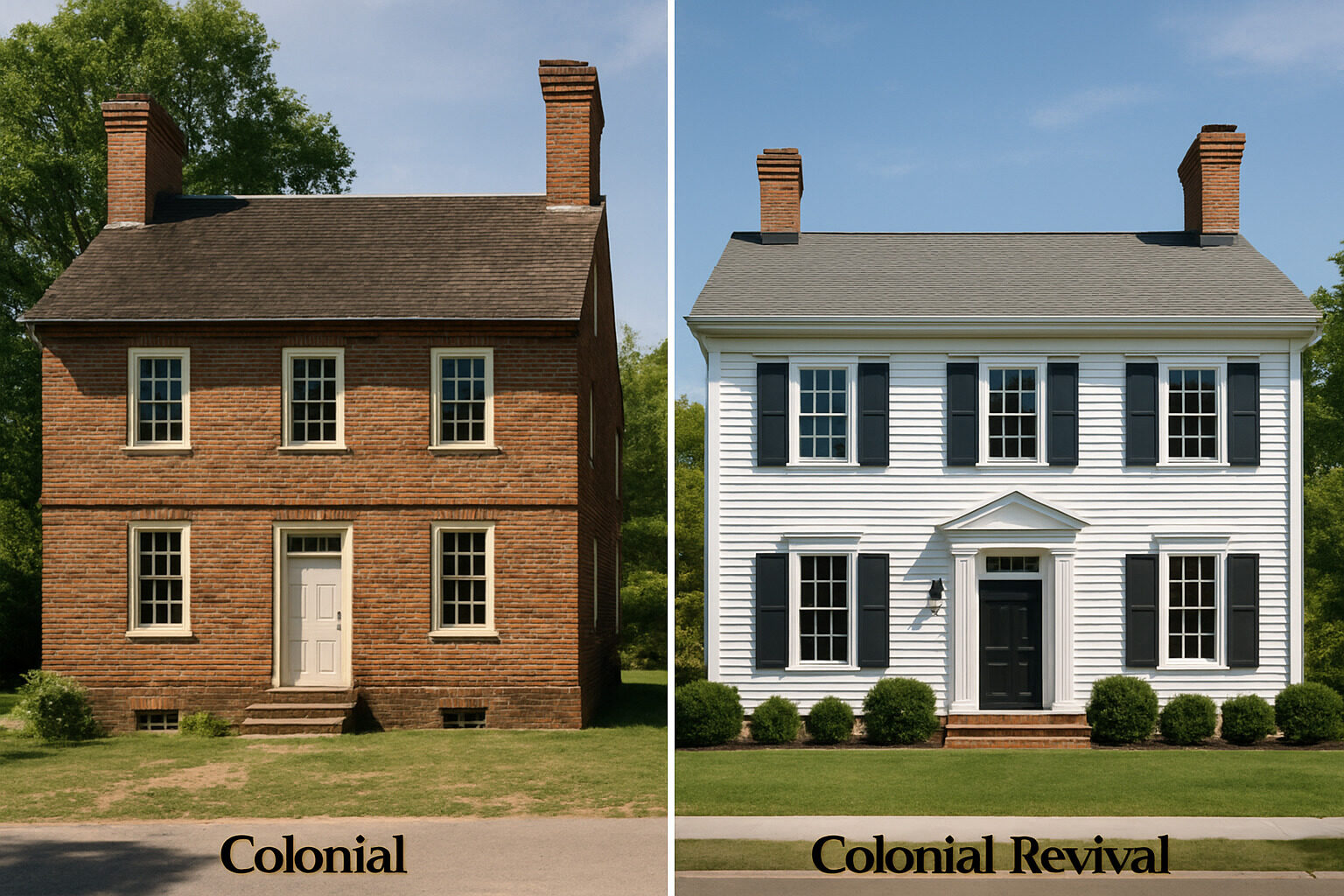
The Two at a Glance
| Feature | Colonial (original) | Colonial Revival |
|---|---|---|
| Built | About 1600 to 1780 (Federal follows, 1780 to 1830) | About 1880 to 1955 for the classic period; still built today |
| Where | Only where colonists built: the East Coast, the Southwest, Louisiana | Everywhere |
| Window panes | Many small panes: 9-over-9, 12-over-12, or 6-over-9 | Fewer, larger panes: 6-over-6, 8-over-8, or 1-over-1 with grilles |
| Scale | Modest; ceilings around 7 feet; small rooms | Larger; 8 to 9 foot ceilings; wider facades with wings and attached garages |
| Entry | Plain paneled door, sometimes a transom above | Fanlight, sidelights, and a columned portico or pediment |
| Structure | Heavy timber frame; brick or fieldstone foundation | Stud framing; poured concrete or block foundation |
| Symmetry | Symmetrical in Georgian examples; earlier houses are irregular | Almost always symmetrical at the core, often with side wings |
| Chimney | Massive central chimney (New England) or paired end chimneys (Georgian) | Smaller, often decorative, at one or both ends |
Colonial: Several Regional Originals
Colonial is a period, not a single style, and the originals vary by who settled where. In New England the earliest houses were steep-roofed timber frames with a huge central chimney, growing into the saltbox with its long rear roof slope and the one-and-a-half-story Cape Cod. From about 1700 the Georgian style brought classical order: a symmetrical facade, a centered paneled door with a transom or small crown, evenly spaced sash windows with many small panes, paired chimneys, and a cornice with dentils, in brick to the south and clapboard to the north. Dutch settlers in the Hudson Valley built gambrel-roofed houses; Spanish colonists in the Southwest built in adobe with flat roofs and thick walls; the French in Louisiana built raised houses with hipped roofs and deep galleries. After independence the Federal style refined Georgian with slimmer proportions, elliptical fanlights, and delicate ornament, and it is often lumped in with Colonial.
What all the originals share is restraint imposed by the means available: hand-blown glass in small panes, hand-hewn timber, local brick and stone, low ceilings to hold heat, and ornament limited to the doorway and cornice. Our guide to cross-cultural influences in colonial architecture covers how those regional versions borrowed from one another. Browse originals and their descendants in the Colonial section of the library.
Colonial Revival: The Look, Enlarged
The revival began with the Centennial Exhibition of 1876, when Americans rediscovered their eighteenth-century houses as a national heritage. Architects such as McKim, Mead and White measured old houses on tours of New England and then designed new ones that were freer and much larger. By the 1890s the style was mainstream, and it dominated American housing from the 1910s to the 1950s: Georgian-inspired brick houses, white clapboard versions with green shutters, the Dutch Colonial with its gambrel roof, and from the 1930s the Cape Cod revival that Royal Barry Wills made the default small house of postwar suburbs. The restoration of Colonial Williamsburg in the 1930s gave the movement a set of officially sanctioned models, and the style has never really gone away: many houses built in the 2000s are Colonial Revival in everything but the window glass.
What to look for: a symmetrical core with a side wing or attached garage the originals never had; an entrance that does too much, with a fanlight, sidelights, pilasters, and a pediment or portico all at once; six-over-six or larger panes; shutters that are decorative and often too narrow to cover the window; a brick veneer over wood framing; and interior ceilings a foot or more taller than any colonial builder used. See how the revival looks in older cities in Boston, Philadelphia, Savannah, and New Orleans, or browse the full Colonial Revival library.
Where the Confusion Comes From
- Listings call everything Colonial. Real estate shorthand uses Colonial for any symmetrical two-story house with shutters, almost all of which are revivals.
- Good revivals copy well. Early twentieth-century architects measured originals and reproduced their details faithfully; only the scale and the glass give them away.
- Originals have been altered. A genuine 1750 house with 1920s windows, a 1950s portico, and a 1990s addition can look more revival than the revival next door.
- The same house types recur. A Cape Cod can be 1740 or 1950. A gambrel-roofed Dutch Colonial can be 1720 or 1925.
A Four-Question Test
- Where is it? Outside the original colonial regions, it is a revival, full stop.
- How many panes per sash? Nine or twelve suggests original glass. Six or fewer suggests revival, or replaced windows.
- How big is the house and how tall are the ceilings? Small rooms and low ceilings are original. Generous ones are revival.
- What is under it? A fieldstone or brick foundation with a low cellar is original. Poured concrete is twentieth century.
If you own the house, the deed and the county assessor's record settle the date. If you are looking from the street, upload a photo and the analysis will separate the Georgian, Federal, and revival influences.
Frequently Asked Questions
What is the difference between Colonial and Georgian?
Georgian is the dominant style of the later colonial period, from about 1700 to 1780, named for the British kings George I through III. All Georgian houses in America are Colonial; not all Colonial houses are Georgian, since the earliest settlers built in simpler medieval-derived forms.
Is a Cape Cod house Colonial?
The Cape Cod form originated in colonial New England, but the great majority of Cape Cods standing today were built between 1930 and 1960 as Colonial Revival houses. Our Cape Cod guide covers both.
Are Colonial Revival houses still built?
Yes. It remains one of the most common styles for new houses in the United States, usually with vinyl or fiber-cement siding, insulated windows with snap-in grilles, and an attached two-car garage.
See this style on real buildings
Browse our library of AI-analyzed buildings and spot the features from this guide in the wild.
Explore the Style