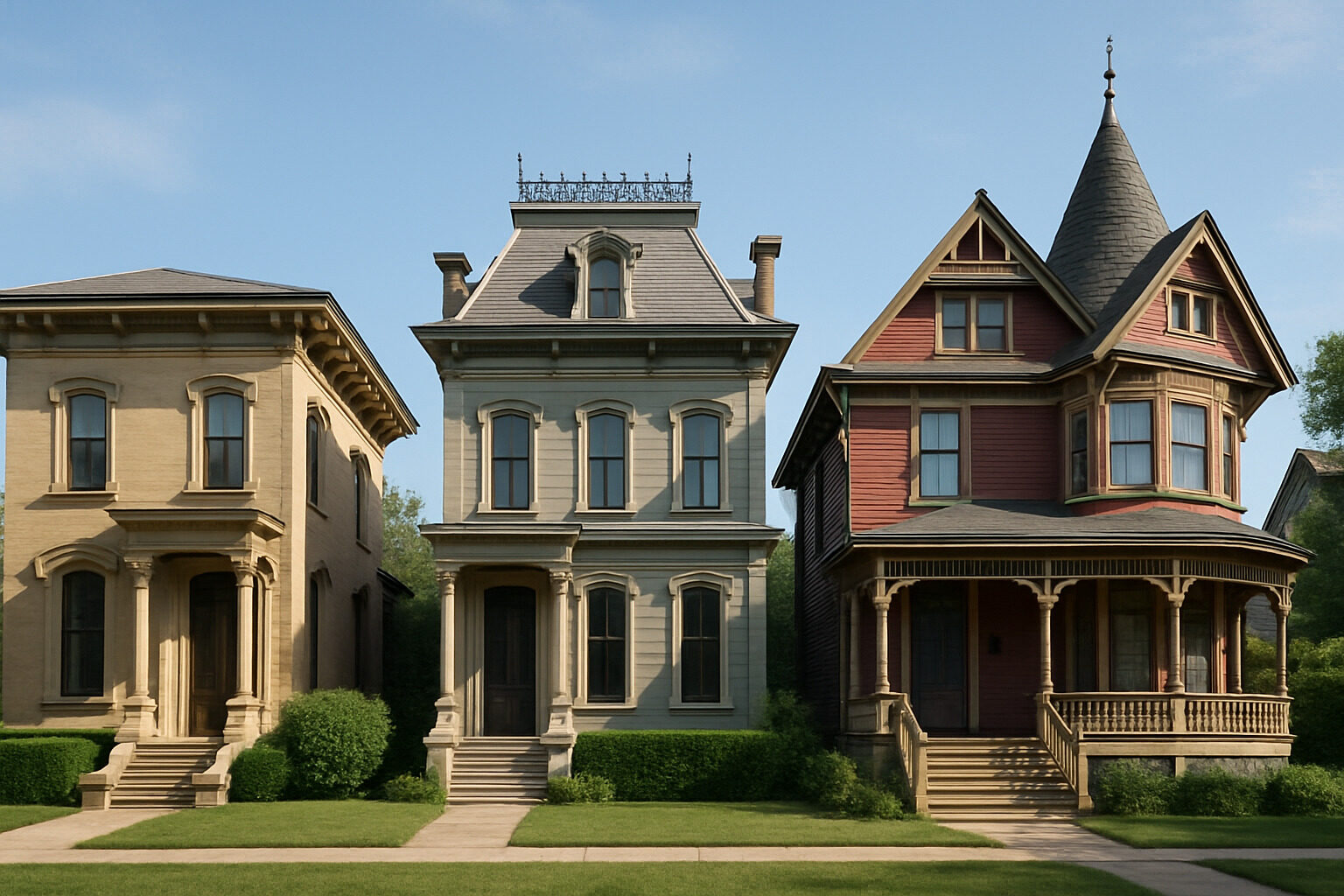
Victorian is not one style. It is the period of Queen Victoria's reign, 1837 to 1901, and the houses built during it fall into several distinct styles that are easiest to tell apart by looking at the roof. A low roof with wide eaves held up by ornate brackets is Italianate. A steep-sided mansard roof with dormer windows is Second Empire. A tall, irregular roof with a front-facing gable, often with a corner tower and a wraparound porch, is Queen Anne. Once you know those three silhouettes you can name most of the Victorian houses on any American street.
What the styles share is an appetite for ornament that mass production had suddenly made affordable. Steam-powered mills turned out brackets, spindles, and patterned shingles by the thousand, railways delivered them anywhere, and balloon framing made complicated shapes cheap to build.
The Main Styles at a Glance
| Feature | Italianate | Second Empire | Queen Anne |
|---|
| Most popular (US) | 1840 to 1885 | 1855 to 1885 | 1880 to 1910 |
| Roof | Low-pitched, usually hipped | Mansard: steep lower slope, nearly flat top | Steep and irregular, with a dominant front gable |
| Giveaway detail | Large decorative brackets under wide eaves | Dormer windows set into the mansard | Corner turret and wraparound porch |
| Windows | Tall and narrow, often round-topped with heavy hoods | Similar to Italianate below the roofline | Bay windows, stained glass, many sizes on one facade |
| Shape | Boxy and symmetrical, sometimes with a cupola | Boxy and symmetrical, sometimes with a central tower | Deliberately asymmetrical |
| Wall surface | Smooth brick, stucco, or clapboard | Brick or clapboard with iron roof cresting | Patterned shingles, spindlework, several textures at once |
Italianate
Italianate houses were loosely inspired by the farmhouses and villas of northern Italy, filtered through English pattern books. The proportions are vertical: two or three tall stories, tall narrow windows, and a nearly flat roof that makes the cornice the star of the show. Those paired brackets under the eaves are the single most reliable marker, which is why the style was sometimes simply called the bracketed style. Many examples have a square cupola or belvedere on top. Because the form suited narrow lots, it also became the standard look for nineteenth-century main street commercial blocks and city row houses. See examples in the Italianate section of the building library.
Second Empire
Second Empire takes its name from the reign of Napoleon III, when Paris was rebuilt with mansard-roofed blocks. The roof was the whole point: its steep lower slope creates a full usable story inside what is technically the attic. Below the roofline, a Second Empire house often looks identical to an Italianate one, with the same brackets and hooded windows, so always check the roof first. Look for patterned slate, dormers with elaborate surrounds, and iron cresting along the top edge. The style was fashionable for public buildings in the 1860s and 1870s and fell out of favor quickly afterward, which makes it useful for dating a neighborhood.
Queen Anne
Queen Anne is what most people picture when they hear the word Victorian, and it has almost nothing to do with the English queen who reigned from 1702 to 1714. The name was borrowed from a British movement led by the architect Richard Norman Shaw, but the American version became its own thing: an asymmetrical composition of gables, bays, and towers, wrapped in a porch and covered in as many textures as the builder could manage. Fish-scale shingles, turned spindles, sunburst panels, and stained glass all appear on the same facade. San Francisco's Painted Ladies at Alamo Square, built in the 1890s, are the best-known examples. Explore how the style varies between San Francisco, Savannah, Denver, and New Orleans.
Other Victorian Styles Worth Knowing
- Gothic Revival (1840 to 1880). Steep gables, pointed-arch windows, and lacy bargeboards along the roof edge. In wood it is often called Carpenter Gothic.
- Stick style (1860 to about 1890). Flat boards applied to the walls in vertical, horizontal, and diagonal patterns, hinting at the frame underneath. It bridges Gothic Revival and Queen Anne.
- Richardsonian Romanesque (1880 to 1900). Heavy rough-cut stone, round arches, and squat towers. More common for libraries and courthouses than houses.
- Shingle style (1880 to 1900). Queen Anne shapes stripped of ornament and wrapped in a continuous skin of wood shingles, mostly in coastal New England.
A Quick Way to Identify a Victorian House
- Start with the roof. Low with brackets means Italianate, mansard means Second Empire, tall and irregular means Queen Anne.
- Check the symmetry. A balanced facade points to the earlier styles; a lopsided one points to Queen Anne or Stick.
- Look at the windows. Round-topped and hooded is Italianate or Second Empire; pointed is Gothic Revival; a mix of shapes and stained glass is Queen Anne.
- Count the textures. One wall material suggests an earlier house. Three or four suggests the 1880s or later.
Many real houses mix styles, because builders picked features from pattern books rather than following rules. If yours will not fit one category, upload a photo to get every influence ranked, or browse the full Victorian library to find one that looks like it.
Frequently Asked Questions
Is Victorian an architectural style?
Strictly speaking, no. It is a period, and it contains several styles including Italianate, Second Empire, Gothic Revival, Stick, and Queen Anne. In everyday use, Victorian usually means Queen Anne.
What is the difference between Victorian and Edwardian houses?
Edwardian houses, built roughly 1901 to 1914, are generally simpler, lighter, and wider than Victorian ones, with less applied ornament, larger windows, and a stronger influence from the Arts and Crafts movement.
What are the Painted Ladies?
The term describes Victorian and Edwardian houses repainted in three or more colors to show off their detail. It was popularized in the 1970s in San Francisco, where the row on Steiner Street facing Alamo Square is the most photographed example.
See this style on real buildings
Browse our library of AI-analyzed buildings and spot the features from this guide in the wild.
Explore the Style