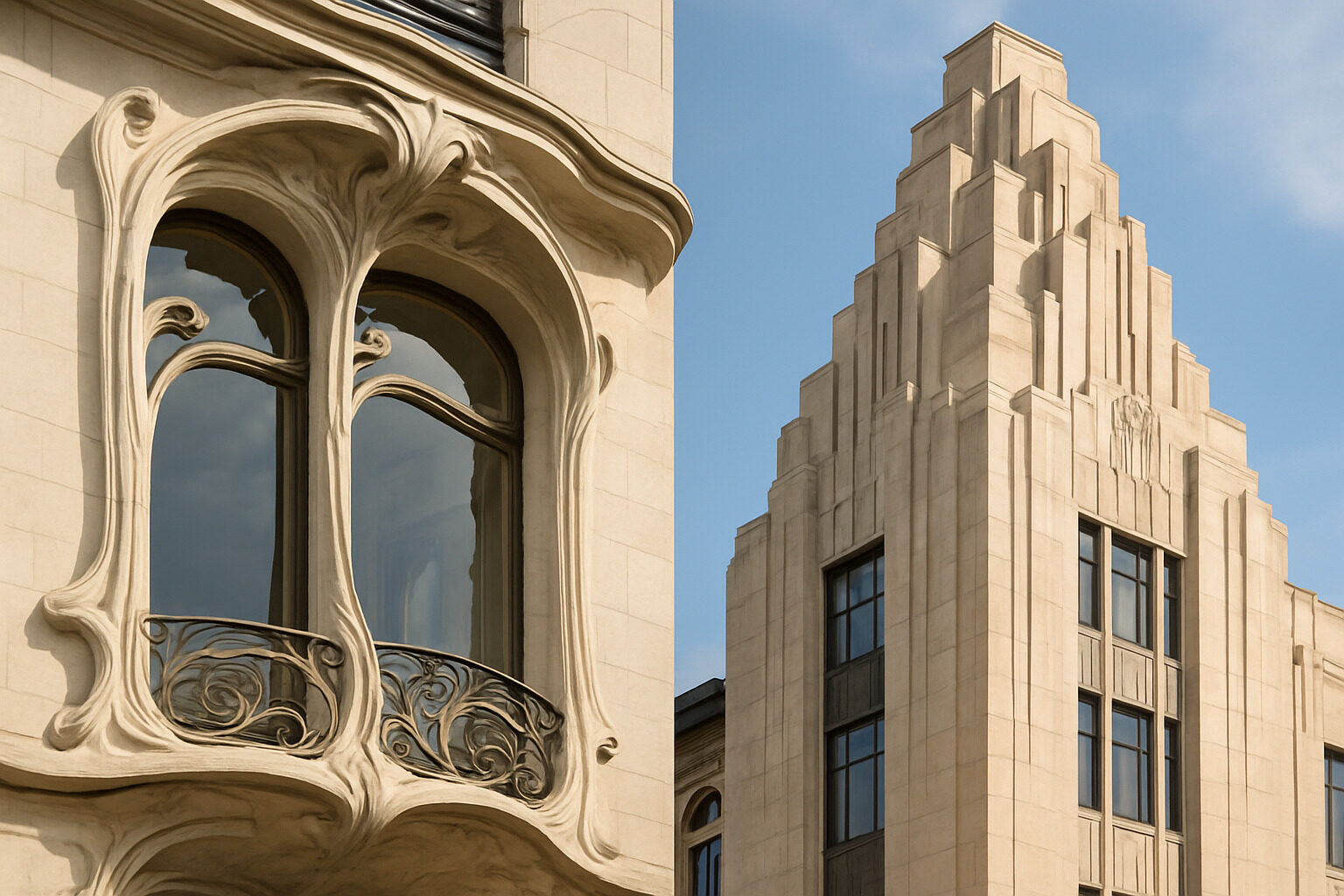
The quickest way to separate the two styles is to look at the lines. Art Nouveau (roughly 1890 to 1910) is built from long, asymmetrical curves borrowed from plants: stems, tendrils, lilies, dragonfly wings. Art Deco (roughly 1920 to 1940) is built from geometry: zigzags, chevrons, sunbursts, and stepped forms that climb toward the sky. One looks grown, the other looks machined. They are often confused because the names are similar and both love ornament, but they are a generation apart and they were reacting to opposite things.
Art Nouveau was a revolt against the historical revival styles of the nineteenth century, and it turned to nature for a vocabulary nobody had used before. Art Deco arrived after the First World War and embraced exactly what Art Nouveau distrusted: industry, speed, repetition, and the glamour of the machine age.
The Two Styles at a Glance
| Feature | Art Nouveau | Art Deco |
|---|
| Peak years | About 1890 to 1910 | About 1920 to 1940 |
| Signature line | The whiplash curve: long, flowing, asymmetrical | Straight lines, zigzags, and stepped setbacks |
| Motifs | Flowers, vines, insects, flowing hair | Sunbursts, chevrons, fountains, stylized eagles and gazelles |
| Symmetry | Often deliberately asymmetrical | Strongly symmetrical |
| Materials | Wrought iron, stained glass, carved stone, ceramic tile | Chrome, stainless steel, glazed terracotta, polished stone, glass block |
| Typical buildings | Townhouses, apartment buildings, metro entrances, cafes | Skyscrapers, cinemas, hotels, department stores |
| Mood | Handcrafted and organic | Sleek, optimistic, machine-made |
How to Spot Art Nouveau
Start with the ironwork. Balconies, stair rails, and door grilles in Art Nouveau buildings twist like vines, and the curve rarely repeats the same way twice. Victor Horta's Hôtel Tassel in Brussels, finished in 1893 and usually named as the first fully Art Nouveau building, carries the same tendril line through its iron columns, floor mosaics, and wall paintings. Hector Guimard's Paris Métro entrances from 1900 do the same thing in cast iron and glass, with lamps that droop like flower buds.
Look next at doors and windows. Openings are often rounded, horseshoe-shaped, or stretched into shapes that no mason would choose for convenience. In Barcelona the local version, called Modernisme, reaches its extreme in Antoni Gaudí's Casa Batlló, where the facade ripples, the balconies look like masks, and the roof arches like the back of an animal. You can see how the style plays out across the city in our guide to Art Nouveau in Barcelona, or browse every example in the Art Nouveau section of the building library.
The style goes by different names depending on where you are: Jugendstil in Germany, the Secession in Vienna, Stile Liberty in Italy. The Viennese version is noticeably more geometric, which is one reason it is sometimes mistaken for early Art Deco.
How to Spot Art Deco
Look up. Art Deco buildings emphasize height with unbroken vertical piers, and tall ones step back as they rise. In New York those setbacks were partly a legal requirement, since the city's 1916 zoning rules forced towers to narrow so that light could reach the street, but architects turned the rule into the defining silhouette of the era. The Chrysler Building (1930) finishes its climb with a crown of stainless-steel sunbursts and eagle gargoyles modeled on car hood ornaments. The Empire State Building followed a year later.
At street level, check the entrance. Deco lobbies and doorways concentrate the ornament: metal grilles with chevrons and fountains, low-relief panels of stylized figures, lettering in tall geometric typefaces. The style takes its name from the 1925 Paris exhibition of decorative and industrial arts, and it never lost that showroom polish.
A later, softer branch called Streamline Moderne swaps the zigzags for rounded corners, horizontal speed lines, and porthole windows, as if the building were an ocean liner. The pastel hotels of Miami Beach mix both versions. Compare Art Deco in Miami with the darker, taller masonry of New York, Chicago, and Detroit, or see all of them together in the Art Deco library.
Where the Confusion Comes From
- The names. Both start with Art and both are French. Nouveau means new; Deco is short for decorative arts.
- Both reject plain walls. Each style treats a building as a total design, down to the door handles and light fittings.
- Transitional buildings exist. Work from about 1905 to 1920, especially from Vienna and Glasgow, flattens Art Nouveau's curves into grids and squares and points directly toward Deco.
- Stylized nature appears in both. Deco uses flowers and animals too, but it freezes them into repeating, symmetrical patterns. If the flower looks like it could wilt, it is Art Nouveau. If it looks stamped from metal, it is Art Deco.
A Three-Question Test
- Are the main lines curved or straight? Flowing curves suggest Art Nouveau; angles and steps suggest Art Deco.
- Is the facade symmetrical? Art Deco almost always is. Art Nouveau often is not.
- What is it made of? Hand-wrought iron and stained glass point to Art Nouveau. Chrome, steel, and glazed terracotta point to Art Deco.
If you have a specific building in mind and the answer is still unclear, upload a photo and the analysis will rank every style influence it finds, with the features that gave each one away.
Frequently Asked Questions
Which came first, Art Nouveau or Art Deco?
Art Nouveau came first. It flourished from about 1890 until just before the First World War. Art Deco emerged in the 1920s and lasted until the Second World War.
Is the Chrysler Building Art Deco or Art Nouveau?
Art Deco. Its stepped crown, sunburst pattern, stainless-steel cladding, and strict symmetry are all textbook Deco features.
Is Gaudí Art Nouveau?
Gaudí belongs to Catalan Modernisme, the Barcelona branch of the broader Art Nouveau movement, though his structural experiments go well beyond what most Art Nouveau architects attempted.
See this style on real buildings
Browse our library of AI-analyzed buildings and spot the features from this guide in the wild.
Explore the Style