Baroque and Rococo are often lumped together, and Rococo is sometimes called Late Baroque, but they feel completely different once you know what to look for. Baroque, from about 1600 to 1750, is heavy, theatrical, and monumental: massive curved facades, giant columns, dark rich colors, gilded domes, and ceilings painted to look like the heavens opening. Rococo, from about 1720 to 1780, is its lighter offspring: pastel walls, white and gold plasterwork curling into shells and scrolls, mirrors, asymmetry, and a mood of pleasure rather than awe. Baroque wants you to fall to your knees. Rococo wants you to enjoy the party. And one more quick test: Baroque happens on the outside of buildings as much as the inside, while Rococo is overwhelmingly an interior style.
Baroque vs. Rococo: How to Tell Them Apart
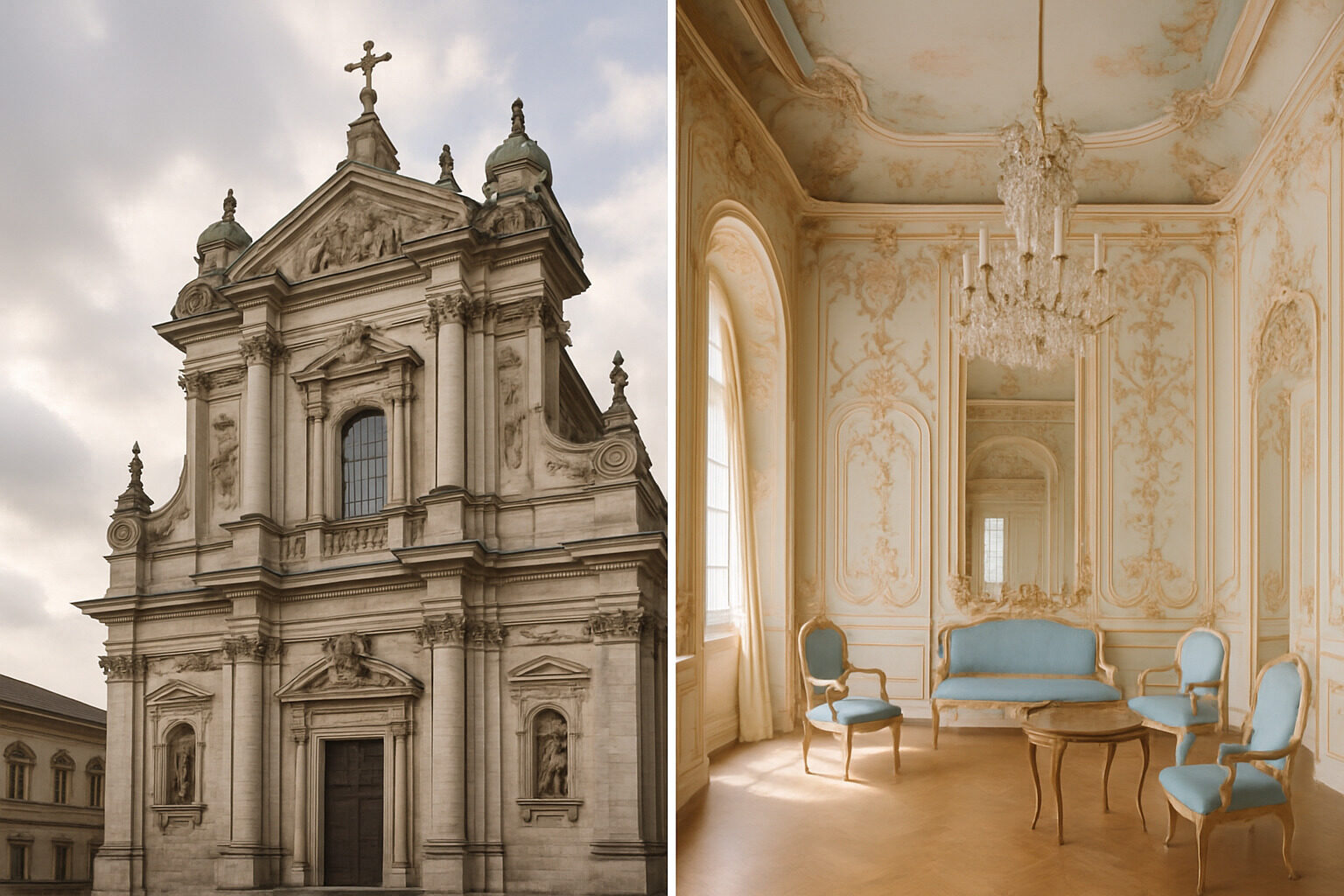
The Two Styles at a Glance
| Feature | Baroque | Rococo |
|---|---|---|
| Dates | About 1600 to 1750 | About 1720 to 1780 |
| Origin | Rome, spreading through Catholic Europe | Paris, spreading to southern Germany, Austria, and Russia |
| Purpose | To express the power of the Church and absolute monarchs | To decorate the private rooms of the aristocracy |
| Scale | Monumental: churches, palaces, city squares | Intimate: salons, boudoirs, garden pavilions |
| Mood | Dramatic, solemn, overwhelming | Playful, witty, light |
| Symmetry | Grand and symmetrical | Deliberately asymmetrical in the details |
| Colors | Deep reds, dark marble, heavy gilding | Pastels, white, pale gold |
| Motifs | Giant columns, broken pediments, twisted columns, saints and angels | Shells, C- and S-scrolls, flowers, ribbons, monkeys and chinoiserie |
| Ceilings | Painted illusions of open sky and ascending figures | Pale, with delicate stucco and light painting |
Baroque: Architecture as Theater
Baroque began in Rome around 1600 as the Catholic Church's answer to the Reformation: art and architecture that would move the faithful through drama and splendor. Gian Lorenzo Bernini's colonnade embracing St. Peter's Square (1656 to 1667) and his bronze baldachin over the high altar are the standard-setters. Francesco Borromini's church of San Carlo alle Quattro Fontane (1638 to 1641) shows the style's other obsession, with a facade that ripples in and out and an oval dome that seems to breathe. From Rome the style spread to Spain, Austria, southern Germany, and Latin America, and in France it became the language of royal power: Versailles, expanded under Louis XIV from the 1660s, is Baroque in its endless symmetry and its Hall of Mirrors. In Protestant England it appears in a more restrained form in Christopher Wren's St. Paul's Cathedral (1675 to 1710).
What to look for on the outside: facades that curve, columns and pilasters stacked two stories tall, pediments that are broken open in the middle, statues along the roofline, and a dome. Inside: colored marble, gilded bronze, sculpture that seems to move, and ceilings painted so that the architecture appears to continue up into the sky. The overall effect is heavy and intentionally overwhelming. You can see Baroque buildings in context in our guides to Kraków and Bruges, or browse the full Baroque section of the library.
Rococo: Baroque Lets Its Hair Down
Rococo began in Paris in the years after Louis XIV died in 1715, when the court left the crushing formality of Versailles and the aristocracy built townhouses in the city. Their interiors were smaller, and their decorators, notably Juste-Aurèle Meissonnier and Germain Boffrand, filled them with a new ornament based on rocaille, the shell-and-rock work of grottoes, from which the style takes its name. Boffrand's oval salon in the Hôtel de Soubise (1730s) is the textbook interior: white walls, gilded scrolls that ignore the corners and flow across them, paintings set into the curves, and mirrors facing windows so the room seems to dissolve.
The style traveled to southern Germany and Austria, where it went from salons into churches. The Wieskirche in Bavaria (1745 to 1754) by Dominikus Zimmermann is a plain building on the outside and a froth of white, gold, and pastel stucco inside. The Amalienburg hunting lodge at Nymphenburg near Munich (1734 to 1739), by François de Cuvilliés, has a hall of mirrors in silver and pale blue that is arguably the most complete Rococo room anywhere. What to look for: asymmetrical scrollwork, motifs from nature rendered delicately rather than grandly, pale colors, and an absence of the heavy classical orders that Baroque relied on. By the 1760s critics were calling it frivolous, and Neoclassicism replaced it within a generation. See examples in the Rococo section of the library.
Where the Confusion Comes From
- They overlap in time. Baroque churches were still being finished while Rococo salons were being decorated, and many buildings have Baroque exteriors with Rococo interiors added later.
- Both are ornate. Someone used to plain modern buildings may see only the gilding and miss the difference in weight and mood.
- The label Late Baroque. Many textbooks treat Rococo as the final phase of Baroque rather than a separate style, which is defensible but blurs a real difference in intent.
- German churches. In Bavaria and Austria the Rococo was used for churches, the one building type most people associate with Baroque.
A Three-Question Test
- Are you outside or inside? Elaborate exteriors are almost always Baroque. Rococo rarely shows on a facade.
- Heavy or light? Dark marble, deep color, and giant columns are Baroque. White, pastel, and gold with no visible structure is Rococo.
- Symmetrical or not? Look at a single panel of ornament. If the left half mirrors the right, it is Baroque. If the scrolls run off in one direction, it is Rococo.
For a specific church or palace, upload a photo and the analysis will separate the influences.
Frequently Asked Questions
Is Versailles Baroque or Rococo?
Mostly Baroque. The palace's exterior, the Hall of Mirrors, and the state apartments are Baroque. Some private rooms decorated under Louis XV in the 1730s and 1740s are Rococo.
Is Rococo just Late Baroque?
You can call it that, and many historians do. But Rococo abandoned the Baroque's classical framework, its monumental scale, and its religious and political purpose, which is enough for most people to treat it as a style of its own.
What replaced Rococo?
Neoclassicism, from the 1760s onward. Excavations at Pompeii and Herculaneum revived interest in ancient models, and Rococo came to look frivolous by comparison.