Brutalism is a branch of Modernism, not its opposite, so the question is really how to tell the raw-concrete branch from the rest of the tree. The quick answer: mainstream Modernism from the 1920s onward is light, smooth, and transparent, built from steel, glass, and white-rendered walls, and it tries to look weightless. Brutalism, which flourished from the mid-1950s to the mid-1970s, is heavy, rough, and opaque, built from exposed concrete that still shows the grain of the wooden boards it was poured against, and it wants you to feel its weight. If the building looks like a machine, it is Modernist. If it looks like a monument carved from a single block, it is Brutalist.
Brutalism vs. Modernism: How to Tell Them Apart
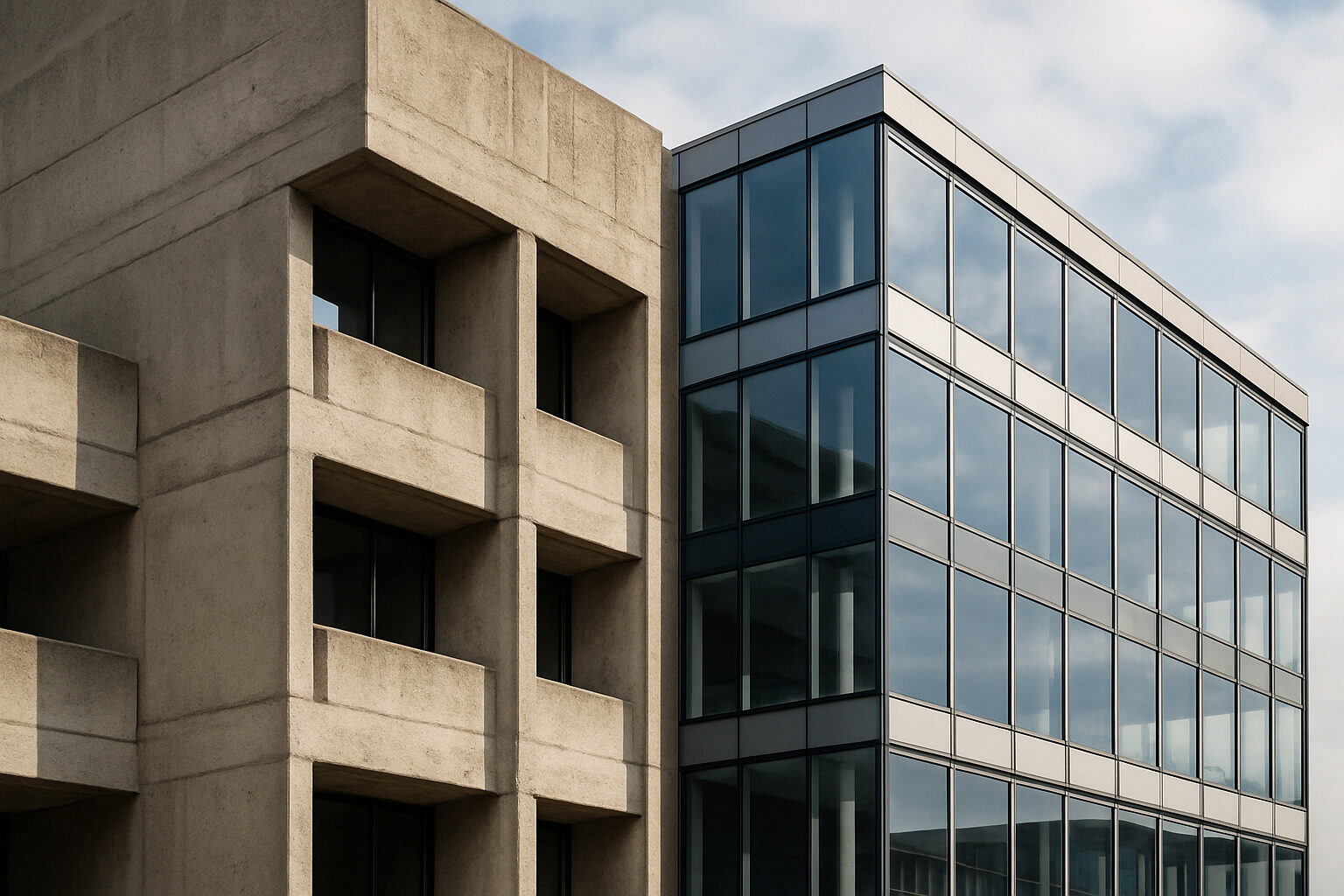
The Two at a Glance
| Feature | Modernism (International Style) | Brutalism |
|---|---|---|
| Peak years | 1920s to 1960s | Mid-1950s to mid-1970s |
| Signature material | Steel frame, glass curtain wall, white stucco | Exposed, board-marked reinforced concrete |
| Surface | Smooth, flat, machine-precise | Rough, textured, showing how it was made |
| Windows | Large expanses of glass; horizontal ribbon windows | Small, deep-set openings punched into thick walls |
| Form | Thin planes, slender columns, boxes lifted on stilts | Massive blocks, cantilevers, stacked and repeated modules |
| Feeling | Light, open, weightless | Heavy, sheltering, monumental |
| Typical buildings | Office towers, villas, pavilions | Universities, civic centers, housing estates, libraries |
| Named examples | Villa Savoye, Seagram Building, Farnsworth House | Unité d'Habitation, Boston City Hall, Barbican Estate, Geisel Library |
Modernism: Less Is More
Modern architecture emerged in Europe in the 1920s from the Bauhaus school in Germany and the work of Le Corbusier in France. Le Corbusier's Five Points of 1927 read like a recipe for the style: lift the building on slender columns, free the floor plan from load-bearing walls, free the facade the same way, run the windows in long horizontal strips, and put a garden on the flat roof. The Villa Savoye outside Paris, finished in 1931, does all five. In 1932 a Museum of Modern Art exhibition named the movement the International Style, and after the Second World War it became the default for corporate America. Mies van der Rohe's Seagram Building in New York (1958), a bronze and glass tower on a plaza, is its most polished expression, and his glass-walled Farnsworth House in Illinois (1951) is the domestic version.
What to look for: flat roofs, walls that read as thin skins rather than heavy masses, columns pulled back from the facade so the glass runs uninterrupted, and an almost total absence of ornament. The residential branch that spread across America from 1945 to about 1970, with its post-and-beam frames, open plans, and walls of sliding glass, is usually called Mid-Century Modern. Browse the broader style in the Modernism section of the library, or city by city in Chicago, New York, and San Francisco.
Brutalism: Concrete as It Comes
The name comes from béton brut, French for raw concrete, the term Le Corbusier used for the unfinished surfaces of his Unité d'Habitation in Marseille, a housing block completed in 1952. The British critic Reyner Banham and the architects Alison and Peter Smithson turned it into a label, the New Brutalism, in the mid-1950s. The idea was honesty: show the structure, show the materials, show the services, and do not dress any of it up. Concrete poured into rough timber formwork keeps the imprint of every board, and Brutalist architects left those marks on display.
The style suited big institutional commissions of the 1960s, when universities, city governments, and housing authorities were building fast and wanted buildings that looked permanent. Boston City Hall (1968) sits on a plaza like an inverted ziggurat of concrete. London's Barbican Estate (built 1965 to 1976) wraps apartments, a school, and an arts center in hammered concrete. William Pereira's Geisel Library at the University of California, San Diego (1970) looks like a concrete tree holding up a stack of glass floors. The forms are sculptural and often top-heavy, with upper floors cantilevered out over smaller bases, and the windows are small and deeply recessed so the walls read as solid mass. See more in the Brutalism section of the library, including examples in Boston, San Diego, Toronto, and Sydney.
Where the Confusion Comes From
- Same family. Brutalism came out of Modernism, kept its flat roofs and lack of ornament, and was designed by architects trained in the Modernist tradition. Le Corbusier is a founding figure of both.
- Concrete is not the deciding factor. Plenty of Modernist buildings are concrete; Frank Lloyd Wright's Guggenheim Museum (1959) is concrete and is not Brutalist. The difference is whether the concrete is left raw and treated as a heavy mass, or smoothed and painted to look light.
- Overuse of the word. Brutalist has become a catch-all for any large, plain, unloved building from the 1960s and 1970s, including many that are ordinary concrete-frame Modernism with panel cladding.
A Three-Question Test
- Does the building look heavy or light? Light, glassy, and thin points to Modernism. Heavy, solid, and sculptural points to Brutalism.
- Can you see the formwork? Board marks, rough texture, and visible joints in the concrete are Brutalist. Smooth, painted, or clad surfaces are Modernist.
- How big are the windows? Walls of glass mean Modernism. Small openings punched into thick concrete mean Brutalism.
Concrete buildings are the hardest to classify from a distance, and many carry both influences. Upload a photo to have the features scored individually.
Frequently Asked Questions
Is Brutalism a type of Modernism?
Yes. It is usually classed as a late phase of Modernism that reacted against the polished glass-and-steel version by emphasizing raw materials and mass.
Why is it called Brutalism if it is not about being brutal?
The word comes from the French béton brut, meaning raw concrete. The overlap with the English word brutal is a coincidence that the style's critics have enjoyed ever since.
Is Brutalism still being built?
Very little new Brutalism has been built since the late 1970s, but interest in preserving the surviving buildings has grown, and raw concrete has returned in the work of architects such as Tadao Ando, though usually in a smoother, more refined form than the originals.
See these ideas on a real building
Upload a photo or type an address and get an instant AI architecture analysis. Your first is free, no account needed.
Analyze a Building Free