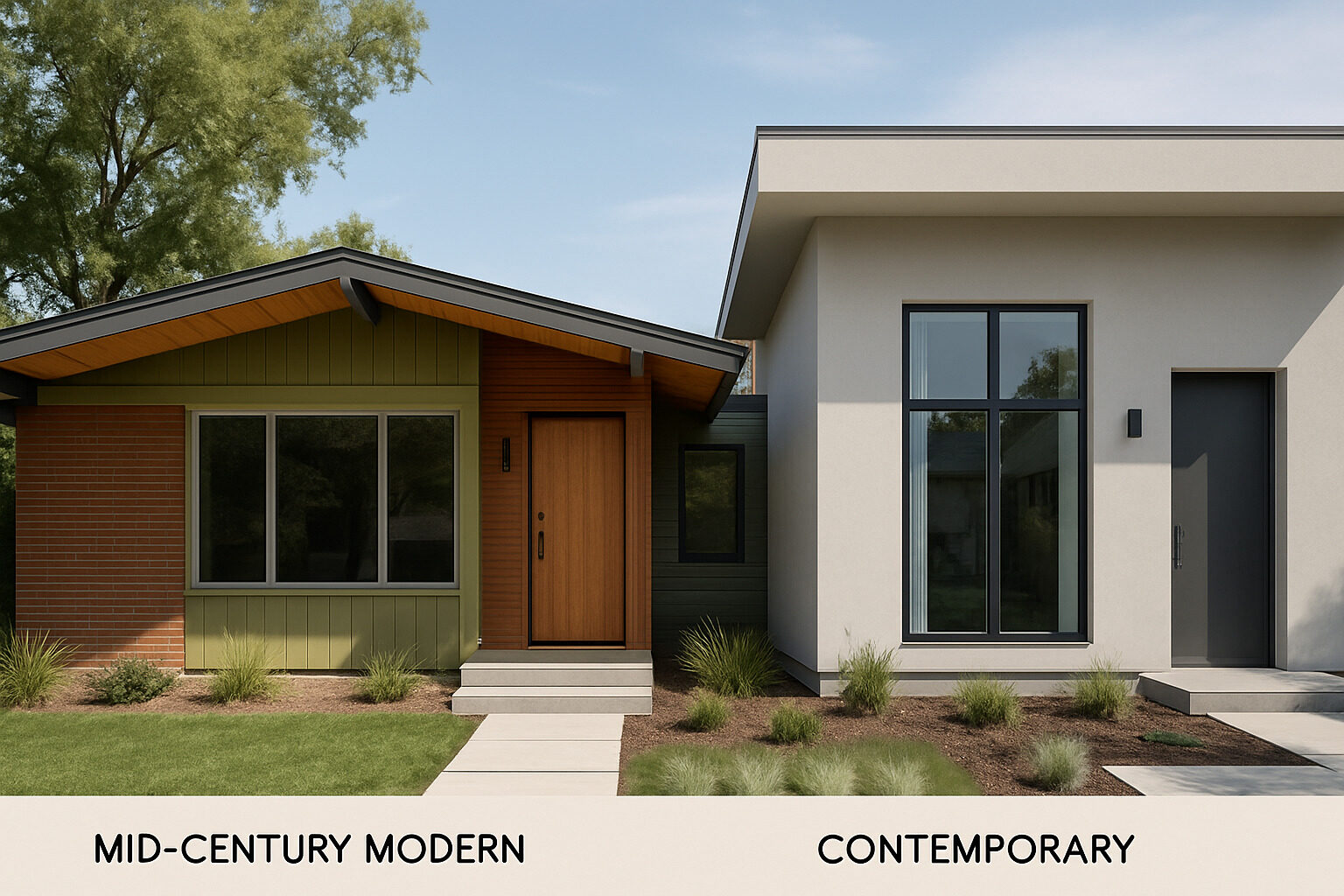
The quickest test is the date. Mid-Century Modern is a period style: houses built from roughly 1945 to 1970, with low or flat roofs, exposed post-and-beam structure, and a wall of glass opening onto the garden. Contemporary is not a period at all; it means whatever is being built now, and today that usually means stacked boxes in mixed materials, tall windows placed where the plan wants them, and a flat or single-slope roof. If the house is one story, horizontal, and its wooden beams run straight through the glass, it is Mid-Century Modern. If it is two or three stacked volumes clad in fiber cement, metal, and stucco, it is Contemporary.
The confusion is partly the word modern. In everyday speech modern means new, so a house finished last year gets called modern. In architecture, Modern is a movement that peaked seventy years ago, and its domestic version is what Mid-Century Modern names.
The Two at a Glance
| Feature | Mid-Century Modern | Contemporary |
|---|
| When | About 1945 to 1970 | Roughly the 1990s to today |
| Roof | Flat, low gable, or butterfly (two slopes meeting in a valley) | Flat with parapets, or a single sloping shed roof, often several at different heights |
| Shape | Long, low, mostly one story, stretched along the site | Stacked, offset boxes; often two or three stories |
| Structure | Post-and-beam, with the beams left visible inside and out | Conventional framing hidden behind cladding |
| Windows | Floor-to-ceiling glass on the garden side; clerestory strips under the roof | Large windows in irregular positions; corner windows; tall vertical slots |
| Materials | Wood, brick, stone, and glass, in their natural colors | Fiber cement, metal panels, stucco, and wood, often several on one facade |
| Palette | Warm wood and earth tones with bright accents | Grays, whites, blacks, and charcoal with one warm material |
| Famous examples | Eames House, Stahl House, Kaufmann Desert House, Eichler tracts | No canon yet; look at any new-build street |
Mid-Century Modern: The Glass Wall and the Beam
Mid-Century Modern is the American domestic version of European Modernism, adapted to a warm climate, cheap land, and the postwar building boom. Its laboratory was Southern California. The Case Study House program, run by Arts & Architecture magazine from 1945 to 1966, commissioned architects to design affordable, reproducible modern houses; Charles and Ray Eames built theirs in Pacific Palisades in 1949 from off-the-shelf steel, and Pierre Koenig's Stahl House of 1960 hangs its glass living room over the Hollywood Hills. Richard Neutra's Kaufmann Desert House in Palm Springs (1946) set the template for the desert version. The developer Joseph Eichler built roughly eleven thousand of the style's most affordable examples across California in the 1950s and 1960s, which is why "Eichler" is still shorthand for a glass-walled post-and-beam tract house.
What to look for: a roof that is flat, barely pitched, or folded into a butterfly; wooden beams that run from inside to outside through the glass, so the ceiling seems to continue into the yard; a blank, private street facade and a fully glazed garden facade; a carport instead of a garage; brick or stone used as a single long wall; and a floor plan that flows around a central atrium or courtyard. Ornament is absent, but the materials are warm and the details are careful. Browse the style in the Mid-Century Modern section of the library, and see where it came from in Brutalism vs. Modernism.
Contemporary: Whatever Is Being Built Now
Contemporary is the style of the present, so its features shift with each decade. The version built since the late 1990s takes Modernism's flat roofs and open plans and adds things Modernists never used: mixed cladding on a single facade, boxes pushed in and out of one another, windows placed for the interior view rather than exterior symmetry, and a strong interest in energy performance, from thick insulation to solar panels and heat pumps. Kitchens open onto living rooms, ceilings are high, and the palette is mostly gray and white with one warm accent, usually a band of wood siding.
What to look for: two or more stacked or offset volumes, each clad differently; a shed roof, or a flat roof hidden behind a parapet; oversized windows that turn corners or run floor to ceiling in unexpected spots; dark metal window frames; and a general lack of eaves. Because Contemporary borrows freely, a given house may also carry Mid-Century, industrial, farmhouse, or minimalist details. See examples in the Contemporary section of the library, and compare the local flavors in Los Angeles, Miami, Toronto, and Sydney.
Where the Confusion Comes From
- The word modern. Buyers and listings use modern to mean new, so Contemporary houses get called modern and then get confused with Mid-Century Modern.
- Shared roots. Contemporary architects grew up on Mid-Century houses and borrow the flat roof, the open plan, and the glass wall directly.
- Renovated originals. Many 1950s houses have been enlarged with second stories and reclad, which turns a Mid-Century house into a Contemporary one in appearance.
- Mid-Century revivals. New houses are sometimes built in a deliberate Mid-Century idiom, complete with butterfly roofs and breeze-block screens. Their build date makes them Contemporary; their look makes them Mid-Century.
A Four-Question Test
- When was it built? Before 1970 points to Mid-Century Modern; after 1990 to Contemporary. The years between produced mostly other styles.
- Can you see the structure? Exposed beams running through the glass are Mid-Century. Hidden framing behind panels is Contemporary.
- How many stories, and how are they arranged? One long, low story is Mid-Century. Stacked or offset boxes are Contemporary.
- How many cladding materials? One or two, in natural colors, is Mid-Century. Three or more, including fiber cement or metal, is Contemporary.
For a specific house, upload a photo and the analysis will score each influence separately, which is useful when a renovation has layered one style over the other.
Frequently Asked Questions
Is Mid-Century Modern the same as Modern?
Mid-Century Modern is the residential, mostly American branch of the broader Modern movement, built between roughly 1945 and 1970. Modern also covers European work from the 1920s onward and commercial buildings such as glass office towers.
Is Contemporary a real architectural style?
It is a label rather than a fixed style: it describes current building rather than a specific set of rules. Historians will eventually give today's houses a period name, as happened with Mid-Century Modern, which nobody called that at the time.
What is an Eichler home?
A house built by the developer Joseph Eichler in California between 1949 and the early 1970s, designed by architects such as A. Quincy Jones and Claude Oakland. They are the best-known affordable examples of Mid-Century Modern, with post-and-beam construction, glass walls facing private gardens, and central atriums.
See these ideas on a real building
Upload a photo or type an address and get an instant AI architecture analysis. Your first is free, no account needed.
Analyze a Building Free